

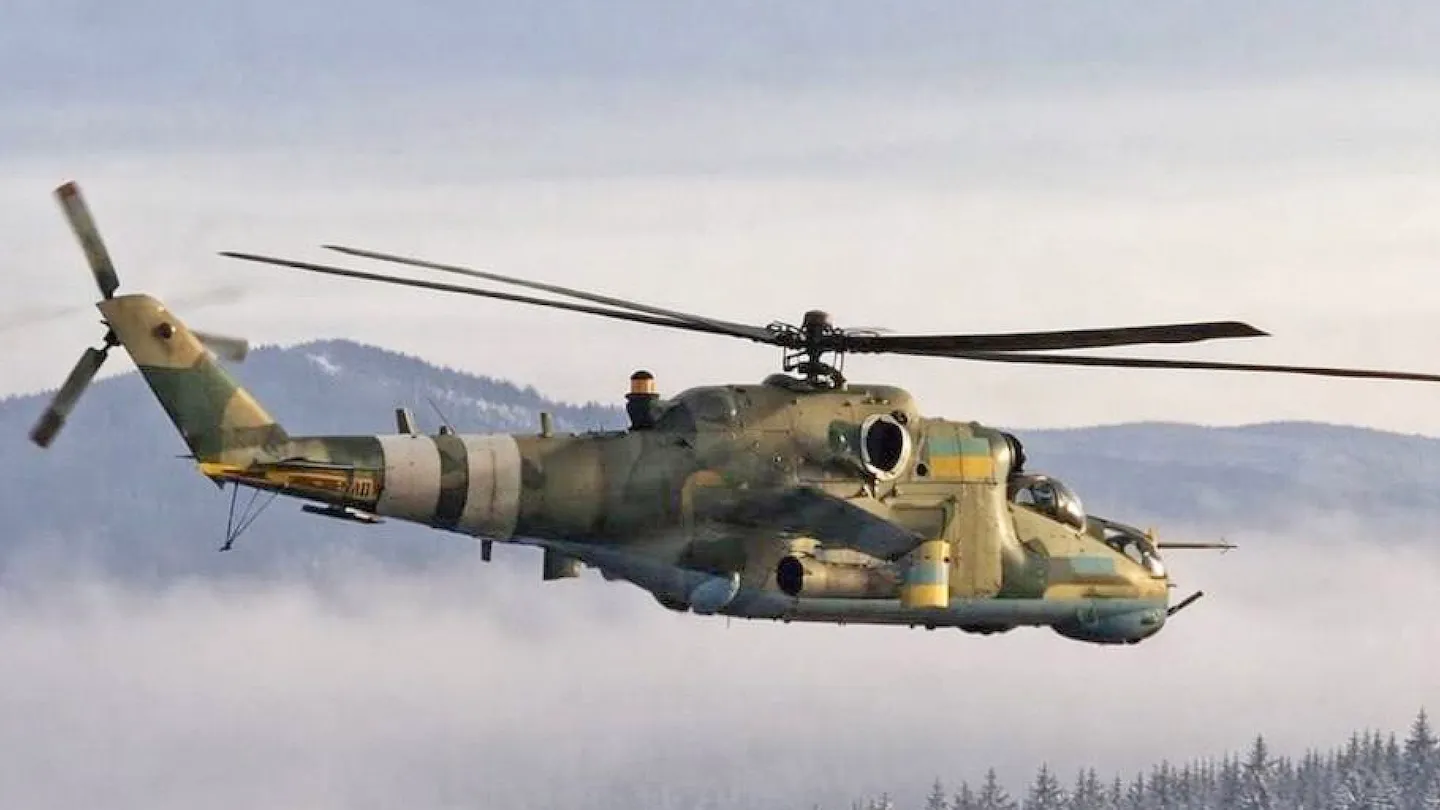
From even before the full-scale invasion that began in February 2022, the Mi-24 Hind series assault helicopter was established as a signature weapon of the conflict between Russia and Ukraine, with extensive combat use during the fight in Donbas. Since the full-scale invasion, both Russia and Ukraine have relied on the Mi-24 primarily as ‘aerial artillery,’ but it’s also been used for special forces work and personnel recovery, and as a drone-killer. Of all the different versions used, perhaps the most unusual, however, is Ukraine’s Mi-24RKhR. This version of the Hind was developed during the Cold War for nuclear, biological, and chemical (NBC) reconnaissance, and first came to prominence in the aftermath of the Chernobyl nuclear disaster.
As of February 2022, Ukrainian Army Aviation was estimated to have around 34 Mi-24s in an operational status, part of an overall fleet of around 100 helicopters, the majority of them Mi-8 Hip series transports. Early losses after the full-scale invasion were heavy, with the total rotary-wing force reduced to around 40 aircraft by October 2022.
The Hind fleet with which Ukrainian Army Aviation started the conflict was dominated by the 30mm-cannon-armed Mi-24P Hind-F version, followed by the Mi-24V Hind-E, with its distinctive four-barrel 12.7mm machine gun in an under-nose turret. There were also much smaller numbers of the Mi-24VP, a sub-variant of the Hind-E with a harder-hitting twin 23mm cannon in a flexible nose mounting.
Ukraine also modernized some of its Mi-24Ps to the Mi-24PU1 standard. This features uprated engines, a new self-protection system to defend against infrared-guided missiles, plus a new target designator for improved firing precision at night. Additionally, the PU1 version adds a Garmin GPS navigation system, an improved cockpit radio, and Polish-made helmets with integrated night-vision devices.
Most unusual of all, however, was the Mi-24RKhR, also known as the Mi-24R (for Razvedchik, Russian for reconnaissance), dubbed Hind-G1 by NATO.
Developed during the Cold War, the Hind-G1 was a dedicated NBC reconnaissance version of the Mi-24, first flown in prototype form in 1978.
Its main feature was the pincer-like sampling gear on the tips of the stub wings. These ‘grabbing hands’ were used to retrieve ground materials for scientific analysis. This was an extremely important role during the Warsaw Pact’s long standoff with NATO, during which troops were expected to fight on battlefields contaminated by the effects of nuclear, biological, and chemical weapons.
In this role, the Hind-G1 superseded the Mi-8VD that had been used for radiological reconnaissance missions since the mid-1970s, and the earlier Mi-2RKhR that was equipped for radiological and chemical reconnaissance.
Many reports suggest that, as part of its modifications, the helicopter had its weapons systems deleted. This isn’t quite the case. While it lost its ability to use the anti-tank guided missiles that were otherwise standard on the ends of the stub wings, the Hind-G1 retained the four-barrel 12.7mm machine gun in the nose and could still carry rocket pods and other unguided stores under the stub wings.
For better protection in an NBC environment, the Hind-G1 had improved cabin seals and a filtration device for air entering the cabin. The crew was further protected from radiation by sheets of lead added to the fuselage. As standard, the four-man crew was provided with additional oxygen bottles, respirators, and protective suits.
Other differences with standard Mi-24s included revised cabin windows, with a long, bulged observation window replacing the two smaller square windows in the right-hand cargo door.
To make an NBC analysis, the Hind-G1 would touch down, and the ‘grabbing hands’ would extend to the ground. Each of these consisted of three small probes placed on the end of an articulated mechanical arm, allowing six soil samples to be taken.
Within the cargo compartment were two operator workstations. At one of these was a console used to process the data collected from the analysis and then transform the results into encoded messages. The second operator, the mission chief, transmitted the messages to the relevant command posts and ground troops.
The process of actually analyzing the samples was complex and made use of a variety of equipment. This included a sensor that measured exposure to radioactive gamma rays; a system to detect chemicals and radiation; a gas detector; an air monitoring system with an automatic alarm that responded to toxic aerosols; and a semi-automated chemical recognition system to detect various toxins.
Further equipment could be carried in a special pod under the left outer wing pylon. This contained a standard chemical recognition attache case to collect samples, a dosimeter, another bag to collect NBC material samples, a decontamination kit, chemical alert rockets, and smoke grenades.
Areas could also be marked as safe or contaminated using colored flares launched from a container below the end of the tail boom.
152 examples of the Hind-G1 version were built between 1983 and 1989.
These are known to have been issued to Soviet units based in East Germany, immediately facing NATO forces. They were assigned to independent combat and control helicopter squadrons, which were in turn assigned to regiments or armies. Each squadron had a pair of Hind-G1s, as well as a pair of Mi-24K Hind-G2s, another specialist version of the helicopter, dedicated to artillery spotting.
The Hind-G1 first came to public prominence during the operation in the aftermath of the Chernobyl nuclear disaster, in the Ukrainian Soviet Socialist Republic, in April 1986. Here, the helicopter was used to measure radiation levels, but any examples used close to the devastated Reactor Number Four almost certainly ended up withdrawn from use, due to contamination.
About the Author