

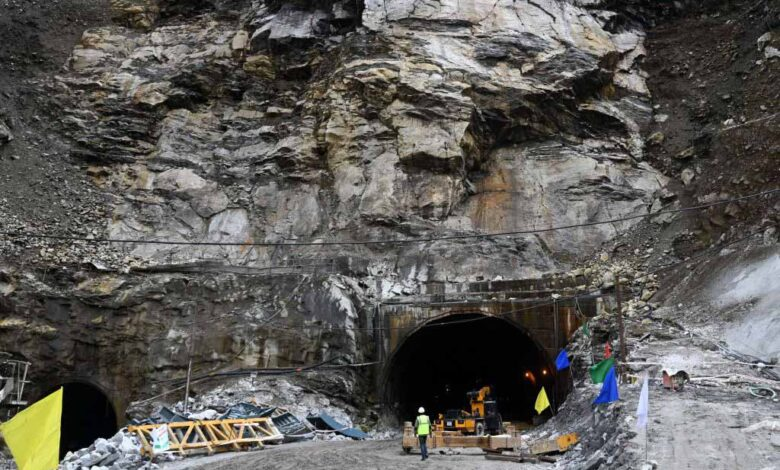
India has launched construction on the 1,840-kilometer Arunachal Frontier Highway, which will run along the Line of Actual Control (LAC) dividing China and India, the world’s longest disputed border.
The highway will stand as India’s strongest infrastructure assertion in the Himalayas, while facilitating troop mobility and strengthening military readiness as a counter to China’s expansionist activity.
China disputes vast stretches of the 3,488-kilometer LAC, which borders five Indian states, and especially resents any activity near the line, such as Indian Prime Minister Narendra Modi’s visit for the $4.73 billion project’s groundbreaking in September 2025. Chinese communist forces invaded and annexed Tibet in the early 1950s, and since then China has also claimed the Indian state of Arunachal Pradesh as its own, calling it Zangnan.
New Delhi rejects China’s attempts to claim sovereignty, such as renaming locations, with the External Affairs Ministry calling Arunachal Pradesh “an integral and inalienable part of India.” It is a view shared by the United States, which reaffirmed its recognition of the state as India’s territory in June 2025.
India’s border with China, much of it poorly demarcated amid rugged mountains, has been the scene of clashes over the decades, including a 1962 war. Twenty Indian Soldiers and at least four Chinese troops were killed in combat in 2020, prompting Beijing and New Delhi to fortify positions and deploy extra troops and equipment.
The competing territorial claims of the nuclear-armed neighbors, the world’s most populous nations, also have prompted an infrastructure contest in the inhospitable terrain. Both countries have sought to improve connectivity and enhance military preparedness by facilitating forward deployment of troops, vehicles, warplanes, drones and heavy equipment.
China’s development of dual-use infrastructure — such as roads, railways and bases that can be used for civilian or military purposes — has driven India to invest heavily in the region over the past decade.
The Arunachal Frontier Highway will run within 20 kilometers of the border, enabling enhanced surveillance of Chinese activity, Indian defense officials say. Monitoring is intended to thwart unprovoked transgressions, such as the December 2022 clash between People’s Liberation Army (PLA) troops and Indian Soldiers in the Tawang sector.
India completed the strategic all-weather Daulat Beg Oldi road in 2020, enhancing connectivity along the LAC in Ladakh. The 255-kilometer carriageway leads to the world’s highest airstrip and military base, located 12 kilometers south of the strategic Karakoram Pass and 7 kilometers south of a PLA military post at Shenxianwan.
China, in turn, built a 36-kilometer road in the Shaksgam Valley, which Pakistan ceded to China in 1963 when they settled their border dispute, even while the territory was claimed by India.
Pakistan has given China access to its air force bases in Skardu and Gilgit in the Gilgit-Baltistan region. China upgraded the airfields to enable PLA Air Force (PLAAF) warplanes to reach India far more quickly than from air bases in Tibet and Xinjiang in northwest China.
India views China’s intrusions as “salami slicing,” whereby Beijing seeks to incrementally gain control of territory with the intent to redraw long-established maps. As part of its deception, China is constructing dual-use villages and installations and transforming civilian settlements to military enclaves and civilian airfields to PLAAF bases. It has built up to 628 defense villages from eastern Ladakh to Arunachal Pradesh, including some on disputed territory.
Meanwhile, 37 airports and heliports have been built or upgraded in Tibet and Xinjiang since 2017, the Center for Strategic and International Studies, a U.S.-based think tank, reported in 2024. “The new facilities also fill large gaps along the Indian border where there were previously no airports,” the report stated. “If PLAAF units are based at these airports, China will gain several new nodes along the border from which to project airpower into India.”
China also built a second bridge across Pangong Tso, a saltwater lake that straddles eastern Ladakh and Tibet. The bridge can carry armored columns and cuts deployment time from 12 hours to four. Its construction was prompted by an Indian Army operation in 2020 that outmaneuvered the PLA to occupy the neighboring Kailash Range and dominate the strategically significant mountain pass of Spanggur Gap on the LAC.
China continues to build military infrastructure and maintain a heavy troop presence along the LAC despite long-running diplomatic efforts to ease tensions and an October 2024 bilateral agreement on patrolling rights in Depsang and Demchok, the last two major friction points.
In response, India inaugurated a strategic bridge over the Siyom River near the LAC in early January 2023 as part of the Defence Ministry’s construction of more than 20 bridges, three roads and other infrastructure.
That followed more than 70 Indian projects in 2022, including 45 bridges, 27 roads and two helipads. That same year, New Delhi said it had spent more than $2 billion on constructing 2,088 kilometers of border roads over the previous five years. India also inaugurated 125 projects in December 2025, including 93 bridges and 28 roads.
“Building connectivity in as many border regions as possible is our government’s priority so that along with development, the people living in these areas also have a sense of assurance,” Indian Defence Minister Rajnath Singh said.
Sarosh Bana is executive editor of Business India in Mumbai, regional editor, Indo-Pacific Region, of Germany’s Naval Forces journal, and India correspondent of Sydney, Australia-based cyber security journal Asia Pacific Security Magazine.
About the Author