
Taiwan has begun co-producing 155mm (6.1-inch) artillery shells with the US, as the island moves to strengthen wartime ammunition resilience amid Beijing’s escalating military pressure and concern over supply disruptions in a high-intensity conflict.
Taiwan’s defence ministry on Monday said Taipei and Washington had launched early-stage joint production of a new type of 155mm howitzer ammunition.
Lieutenant General Lin Wen-hsiang, head of Taiwan’s Armaments Bureau, testified during a legislative session that the Ukraine war underscored the urgency of securing a sustained ammunition supply in the event of an armed conflict.
“For defence resilience and because the Ukraine war has demonstrated that 155mm howitzers are among the fastest-consumed artillery systems, we have already begun preliminary work with the United States, starting with joint production of 155mm howitzer ammunition,” Lin said.
“If successful, this will then be expanded to other weapons and munitions,” he added.
Details of the Taiwan-US arrangement remained classified, Lin said. He described the project as part of a broader push to enhance Taiwan’s “defence resilience”.
In a report submitted to the legislature on Monday, the defence ministry said Taiwan faced particular challenges in resupplying ammunition during wartime, when sea and air transport could be “disrupted by a blockade or missile strikes”.
As a result, the military was prioritising local production and deeper cooperation with allies to reduce reliance on external supply chains, according to the report.
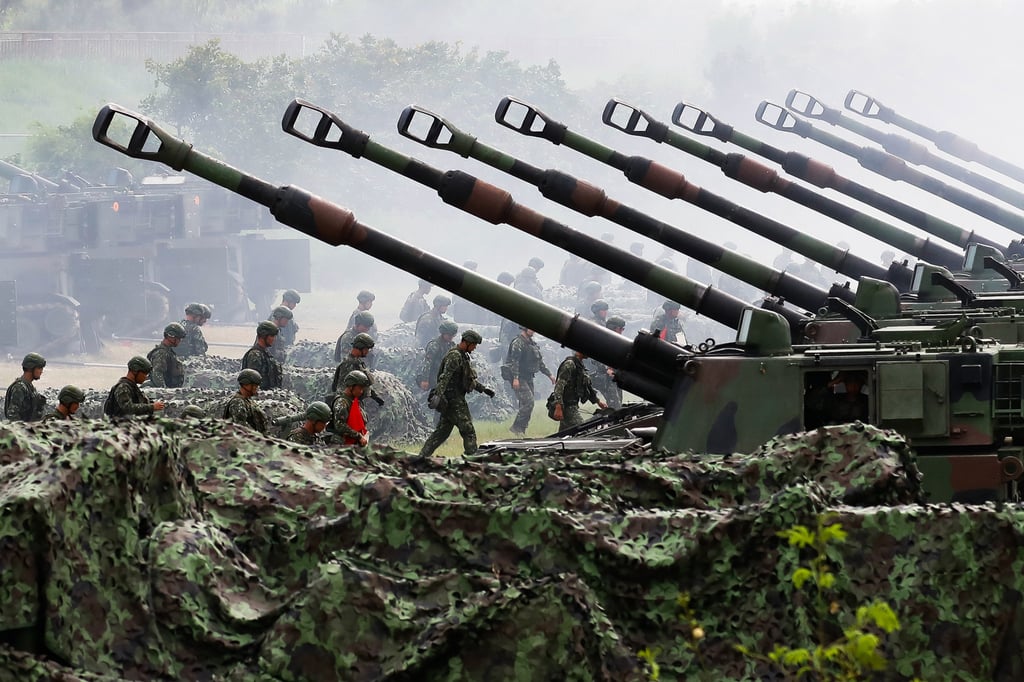
Military sources said the joint production effort was closely linked to Taiwan’s planned acquisition of US-made M109A7 Paladin self-propelled howitzers, which have longer barrels and require higher chamber pressure than existing systems.
Taiwan’s home-grown ammunition was incompatible with the new platforms, prompting the need for production standards aligned with US specifications, the sources added.
Local media have reported that the defence ministry plans to allocate about NT$14 billion (US$442.6 million) to build a new automated artillery ammunition production line at the Armaments Bureau’s 202nd Factory, while upgrading existing facilities to increase output.
The new line is expected to focus primarily on 155mm ammunition, which is in global short supply, as well as other high-demand munitions, according to the reports.
The co-production push forms part of a broader defence-industrial expansion under the government’s proposed NT$1.25 trillion special military spending package announced by Taiwan’s leader, William Lai Ching-te, in November.
Part of the eight-year programme aims to boost deterrence by expanding ammunition stockpiles, strengthening production capacity and deepening defence cooperation with the US.
Beyond shell production, Taiwan is also seeking to overhaul how ammunition is stored and transported.
The island’s defence ministry has earmarked funds under the special resilience budget to upgrade ammunition depots, disperse stockpiles, expand underground storage and adopt mobile logistics to reduce vulnerability to missile strikes.
The co-production effort has drawn support from senior US lawmakers.
In August last year, US Senate Armed Services Committee chairman Roger Wicker said during a visit to Taipei that he believed joint weapons production between the US and Taiwan would eventually be realised, including for uncrewed systems.
“I think there’s going to be joint production and joint efforts,” Wicker, a Mississippi Republican, told reporters, adding that Washington was open to innovation and proposals from Taiwan.
But US defence policymakers have urged pragmatism.
In November, Alexander Velez-Green, then the nominee for US deputy undersecretary of defence for policy, said the co-production should focus on “less technically complex capabilities for which Taiwan has existing workforce and production infrastructure”.
Formal co-production agreements often involved complicated and lengthy negotiations with partners and industry, Velez-Green said.
He argued that Taiwan should prioritise projects that can be delivered quickly to bolster deterrence and support a “denial defence” strategy.
Rupert Hammond-Chambers, president of the US-Taiwan Business Council, said in September that while momentum for co-production was strong at senior levels in both governments, execution remained highly complex.
This was especially the case for technology transfer approvals and dealing with any surplus production beyond Taiwan’s own needs, he added.
Meanwhile, Beijing has condemned the deepening US-Taiwan military cooperation.
Mainland China’s defence ministry has repeatedly said it “firmly opposes” any form of military collaboration between the US and Taiwan, warning that such moves violate the one-China principle and risk destabilising the Taiwan Strait.
Beijing sees Taiwan as part of China to be reunited by force if necessary. Most countries, including the US, do not recognise Taiwan as an independent state, but Washington is opposed to any attempt to take the self-ruled island by force and is committed to supplying it with weapons.
About the Author