
Indonesia’s military force development needs to prioritise capabilities required to enforce neutrality in a Taiwan contingency. Without persistent surveillance and the ability to remain on task over extended periods, the country’s long-standing policy of neutrality risks becoming largely declaratory rather than operational.
Geography dictates that a Taiwan contingency would place pressure on Indonesian neutrality. Indonesia lies directly along the maritime and air routes linking the Indian Ocean and the Pacific Ocean.
In such a conflict, military movement would extend well beyond the immediate theatre. For example, the United States and its allies would have forces and reconnaissance and surveillance equipment on the Indian Ocean side of Indonesia that they would want to project into the Pacific side.
China, on the Pacific side, would want to project force into the Indian Ocean side and keep a watch on what was happening there. It might also try to protect its Indian Ocean shipping.
Movement between the South China Sea and the Pacific Ocean could also mean use of Indonesian airspace or territorial seas and archipelagic waters.
Belligerents’ surface warships, submarines, aircraft and missiles could be involved in all this.
For Indonesia, the task would not be to confront those forces, but to manage proximity: to know what is occurring near or within its waters and airspace and to regulate how belligerent states use them, without becoming a party to the conflict.
For example, a ballistic missile launched by one side might pass through the atmosphere above Indonesia as it ascends to space. Only if Jakarta observed the trajectory could it identify that use of Indonesian airspace and raise the issue with the belligerent state concerned.
Similarly, where naval transit through Indonesia’s straits is ongoing, Jakarta could not require a submarine to keep moving unless it was aware that the vessel had stopped.
And if a belligerent state’s surface warship entered Indonesian waters seeking sanctuary, Jakarta would need to detect that presence before it could insist on the vessel’s departure.
Two capabilities are central to such tasks: surveillance and endurance.
Indonesia’s defence modernisation has focused heavily on high-profile equipment. New surface combatants and submarines improve presence and peacetime signalling. Advanced combat aircraft contribute to deterrence. They bring capabilities that matter, but they do not by themselves determine whether neutrality can be enforced. Neutrality depends less on episodic presence than on persistence. It turns on whether activity can be monitored continuously and over time.
Surveillance is therefore critical. Without sustained maritime and aerial awareness, Indonesia would struggle to detect and attribute behaviour that falls short of open hostilities but nonetheless erodes neutrality.
Persistent maritime awareness is typically provided by long-range air and surface sensors. Subsurface activity is detected through underwater and surface-based acoustic systems. Continuous airspace monitoring relies on airborne and ground-based radar integrated into national air surveillance networks. Without these, observation remains intermittent and attribution uncertain.
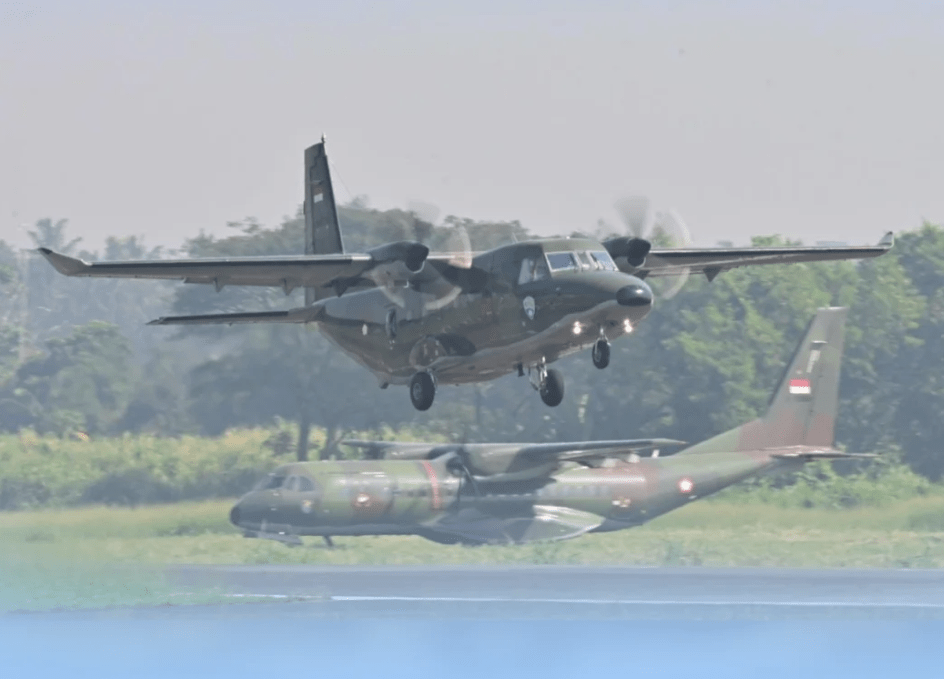
Ship and aircraft endurance presents a similar constraint. Indonesia’s geography demands not just presence but the ability to remain on task. Short patrol cycles and intermittent coverage leave gaps that capable actors can exploit. Indonesia needs the capacity to sustain patrols, to shadow transiting platforms, and to maintain coverage across long distances both at sea and in the air. Without that endurance, surveillance quickly loses practical effect.
Seen this way, Indonesia’s force development reflects a familiar tension between planning for a balanced force and capabilities for specific contingencies. Indonesia has traditionally favoured a balanced force structure, but enforcing neutrality in a Taiwan contingency demands certain capability prioritisation.
This does not suggest that Indonesia needs to prepare to fight major powers. Its more immediate challenge is regulating behaviour short of war within its airspace and waters. Subtle practices that fall short of open hostilities can still erode neutrality over time if they go unobserved or unaddressed. Sustained observation and regulatory presence make it harder for belligerents to operate unnoticed or without constraint. They can thereby be encouraged to adjust their conduct, reducing risk of escalation.
In a Taiwan contingency, whether Indonesia can practically exercise its neutrality will depend on persistent surveillance capabilities, not on diplomatic positioning alone.
About the Author