
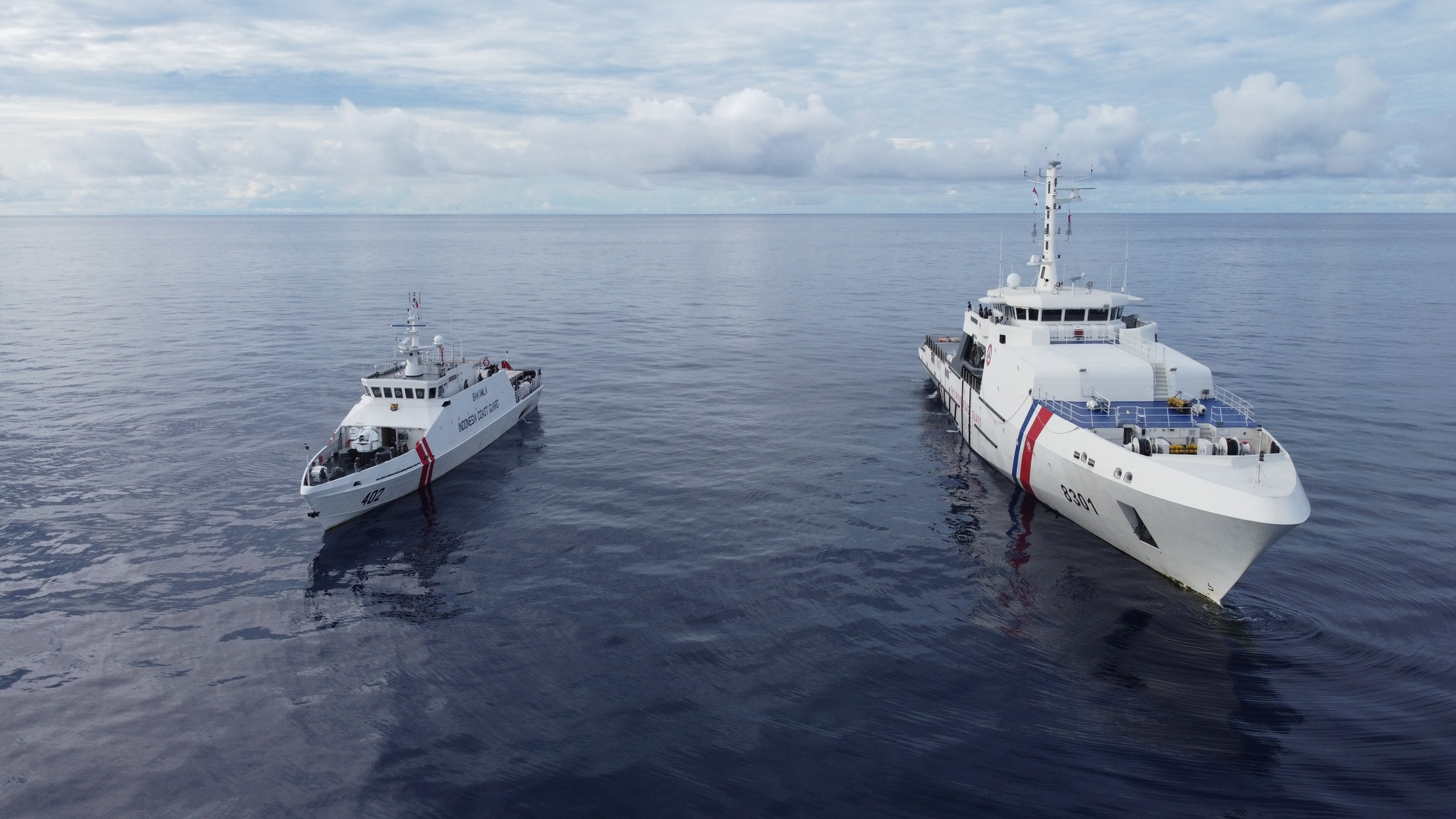
Southeast Asian states need their coast guards to cooperate if they are to withstand and counter Chinese aggression, especially as US uninterest in the South China Sea may embolden China to increase its coercion of other claimant states. Efforts to formalise the ASEAN Coast Guard Forum (ACF) within broader ASEAN frameworks could be just the ticket.
The United States’ National Security Strategy, released in December, prioritised the western hemisphere, a focus exemplified by this month’s military operation in Venezuela. Furthermore, US President Donald Trump was reluctant to discuss the South China Sea conflict during Philippine President Ferdinand Marcos’ visit to the US in July 2025, further suggesting a lack of US interest in the South China Sea. Indeed, the US conducted only one freedom of navigation operation in the South China Sea in 2025.
In this context, the ACF could be an important way to counter Chinese coercion in the South China Sea.
The ACF was established in 2022 and conducted a table-top exercise in 2023 to enhance communication and trust among ASEAN member states’ coast guards. During its third meeting, in 2024, the forum generated two consolidated working drafts on the ACF’s institutionalisation under the ASEAN umbrella. At the same meeting, participants also proposed draft operational working protocols for engagement between coast guard and maritime law enforcement agencies at sea.
Institutionalisation of the ACF would strengthen maritime cooperation and coordination among Southeast Asian coast guards, paving the way for joint patrols in the South China Sea. This would help deter Chinese coercion of claimant states’ fishing and naval vessels.
The ASEAN Maritime Outlook sets a broader operational agenda for the ACF. Released in 2023, the outlook provides a roadmap for ASEAN’s approach to maritime security cooperation, complementing the ASEAN Outlook on the Indo-Pacific. The maritime outlook sought to address Southeast Asia’s maritime-related issues, including illegal, unreported and unregulated fishing, the proliferation of marine pollution and debris, and offshore renewable energy.
A comprehensive set of maritime functions for the ACF would help members address a broad range of maritime issues extending beyond countering China in the South China Sea. This would increase the forum’s credibility—within and outside the region—and prevent Chinese criticism. Going forward, the ACF could collaborate with extra-regional states—including China—for exercises, joint patrols, capacity-building initiatives and training programs.
However, the ASEAN member states need to address the challenges to make the most of the ACF’s institutionalisation.
One is the high sensitivity of ASEAN members about maritime sovereignty. This makes joint patrols a difficult prospect. For example, in 2004 Indonesia, Malaysia and Singapore shelved initial plans of joint patrols of the Malacca Strait, instead preferring coordinated patrols to respect each other’s sovereignty.
Additionally, Southeast Asian coast guards have different organisational structures, as they fall under different ministries, including defence, home affairs and transport. This makes enhancing coordination among coast guards from different states more difficult.
Furthermore, while the ASEAN Information-Sharing Patrol facilitates information exchange between ASEAN navies, regional coast guards lack a similar mechanism. Data sensitivity, varying national policies, and the region’s linguistic diversity may hinder the development of any such mechanism.
If it overcomes those challenges, the ACF could fill the gap left by the absence of a dedicated regional mechanism for interaction between national coast guards, complementing other regional maritime initiatives. Moreover, its institutionalisation would send a collective signal that ASEAN member states can manage their shared maritime space in accordance with international law, which would also serve as a deterrent against Chinese coercion in the South China Sea.
About the Author