
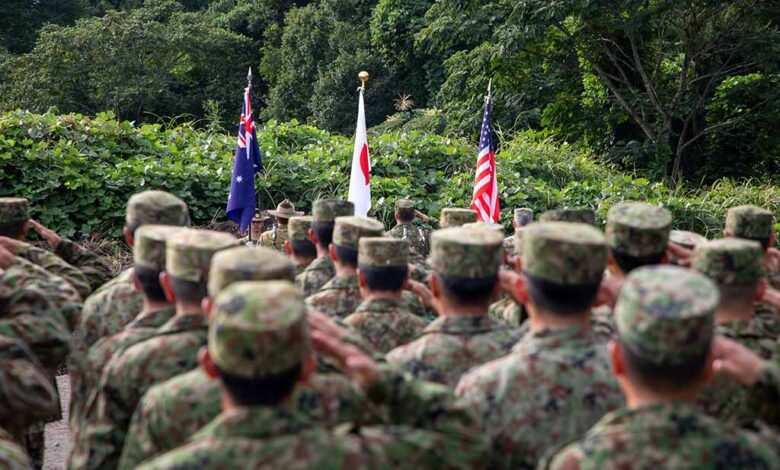
The Australian Defence Force (ADF), the Japan Ground Self-Defense Force (JGSDF) and the United States Army are intensifying efforts to integrate command and control (C2) systems across domains, advancing trilateral readiness for fast-moving contingencies in the Indo-Pacific.
Through command post exercises such as Yama Sakura and Keen Edge, the nations are developing essential enablers of interoperability: shared common operating pictures (COP), coordinated targeting processes and rapid decision-making mechanisms.
Yama Sakura launched in 1982 as a Japan-U.S. exercise. The 2025 iteration in Osaka, Japan, included more than 3,000 personnel from the three forces.
Interoperability hinges on a shared mindset among the forces’ commanders and staff, according to retired Lt. Gen. Koichi Isobe, former commander of the JGSDF Eastern Army. From that foundation, critical tools such as a trilateral COP — a shared real-time visual display of troop positions, enemy locations, terrain, logistics and other information — become possible.
“It would be best if we could share the COP among the three armies on a regular basis. Thus, it could help enormously in case of crisis,” Isobe, who serves as an advisor to the Yama Sakura series, told FORUM.
To address cross-domain threats such as cyber, space, information and psychological warfare, the trilateral forces are expanding collaborative training. For example, Exercise Keen Edge 2024, which included Australian forces for the first time alongside Japanese and U.S. personnel, integrated the U.S. Cyber Command and the U.S. Space Command.
Isobe emphasized that preparing for such threats must go beyond exercises to include daily information sharing. “Warfare in such new domains has already begun in peacetime,” he said.
Emerging technologies such as artificial intelligence are central to accelerating decision cycles. In an era of competition, “quick decision-making among coalitions is crucial,” Isobe said.
These priorities are reinforced in exercises such as Orient Shield, which in September 2025 tested alignment in cross-domain operations among Australia, Japan and the U.S. Such engagements reinforce the Indo-Pacific’s integrated deterrence architecture, Isobe said.
About the Author