
Following US’ latest round of tariff threats against Canada, Canadian Prime Minister Mark Carney on Saturday local time called on citizens to “buy Canadian” in response to “threat from abroad.”
Carney said, “we’re buying Canadian, and we’re building Canadian” on X on Saturday local time, after US President Donald Trump threatened on Saturday to impose 100 percent tariffs on Canadian goods if the country “makes a deal with China,” according to CBC News.
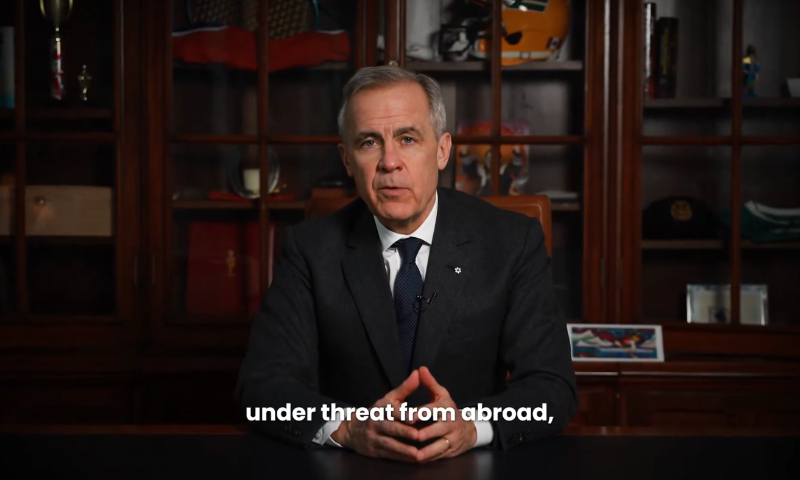
“With our economy under threat from abroad, Canadians have made a choice: to focus on what we can control,” said Carney in a pre-recorded video posted on his personal social media account.
While not directly naming the US, Carney reiterated his commitment to advancing a new “Buy Canadian” policy. He emphasized: “We can’t control what other nations do. We can be our own best customer. We will buy Canadian. We will build Canada. And together, we will build Canada strong.”
The post came after Trump on Saturday threatened to slap a 100 percent tariff on Canadian goods coming into the US.
Trump wrote in a post on his social media platform, claiming, “If Canada makes a deal with China, it will immediately be hit with a 100 percent tariff against all Canadian goods and products coming into the US.”
Meanwhile, in his message Saturday, Trump called Canada’s leader “Governor Carney,” which he had taken to doing with former Canadian Prime Minister Justin Trudeau in reference to Trump’s suggestion that Canada should become the 51st US state, ABC News reported.
“US President’s 100 percent tariff threat signals that US-Canada differences have evolved from ordinary trade friction into confrontation involving third-country trade, and the US administration attempts to interfere in Canada’s sovereign trade with China,” Li Yong, an executive council member of the China Society for WTO Studies, told the Global Times on Sunday.
The threat was the US President’s latest swipe at Canada after Carney’s visit to China and his highly publicized speech in Davos, Switzerland, said CBC News. At the World Economic Forum in Davos, Switzerland, Carney condemned coercion by great powers on smaller countries without mentioning Trump’s name, the AP reported.
The report by CBC noted that despite the magnitude of Trump’s statement, the federal government sounds, at least publicly, pretty unfazed by the president’s latest threat.
“China-Canada cooperation is a normal, mutually beneficial choice between sovereign countries and should not be targeted by a third party,” said Li Yong.
Carney made a state visit to China from January 14 to 17. As one of the outcomes of China-Canada economic and trade consultations, Canada will initially allow in up to 49,000 Chinese electric vehicles at a tariff of 6.1 percent on most-favoured nation terms.
Correspondingly, China will adjust its anti-dumping measures on canola and anti-discrimination measures on certain Canadian agricultural and aquatic products, in accordance with relevant laws and regulations.
Trump’s latest tariff threat on Canada was also a U-turn from what he said immediately after Carney’s China trip. “It’s a good thing for him to sign a trade deal. If you can get a deal with China, you should do that,” Trump told reporters at the White House on January 16, according to the AP.
Li Haidong, a professor at the China Foreign Affairs University, told the Global Times that it also highlights the inherent unpredictability and swings in the current US foreign policy approach, which could erode external confidence in America’s reliability.
Dominic LeBlanc, Canada’s minister responsible for Canada-US trade, wrote on his X on Saturday that “There is no pursuit of a free trade deal with China. What was achieved was resolution on several important tariff issues.”
When asked about how China views remarks by Carney who said that in recent years “the world has changed dramatically,” and that in recent months, Canada’s relationship with China is “more predictable,” Chinese Foreign Ministry spokesperson Guo Jiakun said on Tuesday that the sound and steady development of China-Canada relations serves the common interests of both countries and is conducive to peace, stability, development, and prosperity in the world.
About the Author