
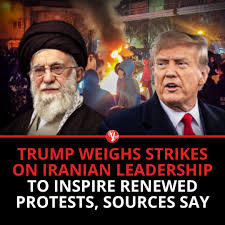
U.S. President Donald Trump is weighing options against Iran that include targeted strikes on security forces and leaders to inspire protesters, multiple sources said, even as Israeli and Arab officials said air power alone would not topple the clerical rulers.
Two U.S. sources familiar with the discussions said Trump wanted to create conditions for “regime change” after a crackdown crushed a nationwide protest movement earlier this month, killing thousands of people.
To do so, he was looking at options to hit commanders and institutions Washington holds responsible for the violence, to give protesters the confidence that they could overrun government and security buildings, they said.
One of the U.S. sources said the options being discussed by Trump’s aides also included a much larger strike intended to have lasting impact, possibly against the ballistic missiles that can reach U.S. allies in the Middle East or its nuclear enrichment programmes.
The other U.S. source said Trump has not yet made a final decision on a course of action including whether to take the military path.
The arrival of a U.S. aircraft carrier and supporting warships in the Middle East this week has expanded Trump’s capabilities to potentially take military action, after he repeatedly threatened intervention over Iran’s crackdown.
Four Arab officials, three Western diplomats and a senior Western source whose governments were briefed on the discussions said they were concerned that instead of bringing people onto the streets, such strikes could weaken a movement already in shock after the bloodiest repression by authorities since the 1979 Islamic Revolution.
Alex Vatanka, director of the Iran Program at the Middle East Institute, said that without large-scale military defections Iran’s protests remained “heroic but outgunned.”
The sources in this story requested anonymity to talk about sensitive matters. Iran’s foreign office, the U.S. Department of Defense and the White House did not respond to requests for comment. The Israeli Prime Minister’s office declined to comment.
Trump urged Iran on Wednesday to come to the table and make a deal on nuclear weapons, warning that any future U.S. attack would be more severe than a June bombing campaign against three nuclear sites. He described the ships in the region as an “armada” sailing to Iran.
A senior Iranian official told Reuters that Iran was “preparing itself for a military confrontation, while at the same time making use of diplomatic channels.” However, Washington was not showing openness to diplomacy, the official said.
Iran, which says its nuclear program is civilian, was ready for dialogue “based on mutual respect and interests” but would defend itself “like never before” if pushed, Iran’s mission to the United Nations said in a post on X on Wednesday.
Trump has not publicly detailed what he is looking for in any deal. His administration’s previous negotiating points have included banning Iran from independently enriching uranium and restrictions on long-range ballistic missiles and on Tehran’s network of armed proxies in the Middle East.
About the Author