
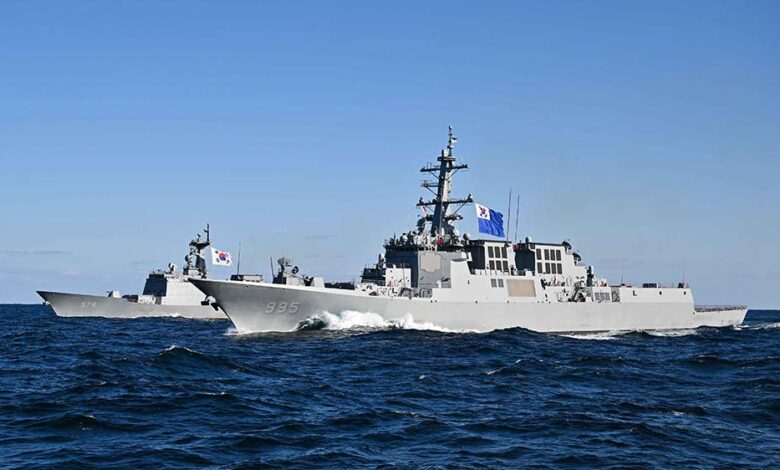
The commander of United States Forces Korea (USFK) recently underscored the Republic of Korea’s (ROK) importance in Indo-Pacific security: Its role extends beyond responding to threats on the Korean Peninsula.
“Korea sits at the crossroads of broader regional dynamics that shape the balance of power across Northeast Asia,” U.S. Army Gen. Xavier T. Brunson, who also is commander of the United Nations Command and Combined Forces Command, said in a December 2025 keynote address at the ROK-U.S. Combined Policy Forum in Seoul.
“The recently published U.S. National Security Strategy reflects this reality by emphasizing the decisive importance of not only this region but of [South] Korea … and the vital role that capable, like-minded partners play in keeping the Indo-Pacific stable and predictable,” Brunson said.
“This peninsula’s geography, the sophistication of the ROK military, and the maturity of our combined command structures give this country strategic weight, the likes of which stretch far beyond our borders,” Brunson said. “When we talk about credible deterrence or maintaining stability across the region, the choices made in Seoul echo much farther than many recognize.”
Brunson has emphasized location as a strategic advantage. He wrote in a November 2025 essay that an “east-up” map — one that rotates the traditional orientation of the region — shows how South Korea is positioned to exert influence across areas that include China, North Korea and Russia.
The U.S. has placed an increasing emphasis on strategic flexibility amid escalating threats from the Chinese Communist Party, North Korea and Russia. In the past two decades, Seoul has expanded its military capabilities with the goal of being able to assume wartime command of combined ROK-U.S. forces, according to the Reuters news agency. The ROK has 450,000 troops while the U.S. has more than 28,000 stationed in the country.
“If the capabilities of our military are greatly strengthened and South Korea takes the lead in defending the Korean Peninsula, the defense burden of the United States in the Indo-Pacific region will also be reduced,” ROK President Lee Jae-myung said in November 2025.
North Korea’s military cooperation with Russia has advanced Pyongyang’s illicit missile and nuclear programs in “dangerous ways,” Brunson said. Those efforts have gained momentum since Moscow’s invasion of Ukraine in February 2022.
North Korean dictator Kim Jong Un “has aided Russia’s war efforts by sending troops and large shipments of artillery shells, missiles and other weapons,” The New York Times newspaper reported. “South Korean intelligence officials and analysts said [that] Russia had reciprocated by providing North Korea with fuel and food, plus materials and technologies to help modernize its military, including its decrepit navy and air-defense systems.”
ROK Defense Minister Ahn Gyu-back, in his speech at the December forum, said cooperation between North Korea and Russia poses a “grave challenge” not only to the Korean Peninsula but also to the international community, according to The Korea Times newspaper.
Ahn recently vowed to swiftly push ahead with the ROK’s bid to build nuclear-powered submarines. Earlier that month, North Korean state-run media released photos of Kim inspecting a factory that built what it claimed was an 8,700-ton, nuclear-powered submarine.
“This is why posture on the peninsula cannot be viewed as a legacy commitment; the threat itself is also modernizing,” Brunson said.
Sentry is a professional military magazine published by U.S. Strategic Command to provide a forum for national security personnel.
About the Author