
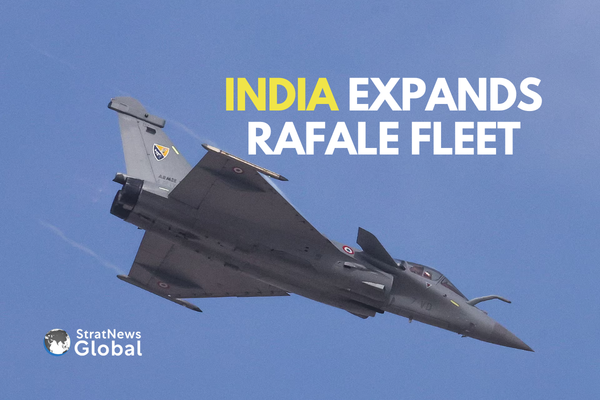
Days before French President Emmanuel Macron lands in India, the government has moved ahead on a cluster of major defence approvals. These include expansion of the Indian Air Force’s Rafale fleet, procurement of additional SCALP long-range cruise missiles from France, and revival of the long-pending deal for six American P-8I maritime patrol aircraft.
The decisions were taken up at the level of the Defence Acquisition Council (DAC), underlining a clear pattern: India is spreading its defence risk.
High-end fighters and strike weapons from France. Long-range maritime surveillance aircraft from the United States. And a parallel push to manufacture more at home under Make in India.
Long Road Back to Dassault
The proposal to acquire 114 multi-role fighter aircraft, expected to translate into more Rafales, marks the return of a requirement that has been circulating in different forms for more than two decades.
After the Kargil conflict, the Air Force wanted more Mirage 2000 aircraft. That plan evolved into the 126-aircraft MMRCA tender. Rafale was declared the lowest bidder in 2012, but negotiations collapsed over cost escalation and disagreements between Dassault Aviation and Hindustan Aeronautics Limited (HAL) on production responsibility.
A government-to-government (G2G) purchase of 36 Rafales in 2016 was meant to be an interim measure. It did not solve the underlying problem: the Air Force today operates around 29 fighter squadrons against a sanctioned strength of 42.
The new 114-aircraft programme is expected to follow a hybrid model; a limited number delivered in flyaway condition and the bulk produced in India. Indigenous content is projected to rise in phases, potentially touching 55–60 percent.
This time, private industry is central. Tata Advanced Systems has signed production transfer agreements with Dassault Aviation to manufacture Rafale fuselage sections in Hyderabad, the first such production outside France. A final assembly line in India is expected if the deal progresses.
SCALP Cleared
Alongside the aircraft, the government has also approved procurement of additional SCALP (Storm Shadow) long-range cruise missiles for the Rafale fleet.
The missile’s clearance comes after its operational use during Operation Sindoor in May 2025. Rafale jets armed with SCALP missiles carried out precision strikes on high-value targets across the border, firing from stand-off ranges while remaining outside heavily defended airspace.
The missile’s low-altitude flight profile and deep-penetration capability allowed strikes against hardened structures. The Air Force is understood to have sought replenishment and expansion of its inventory after the conflict.
Officials privately describe Rafale and SCALP as having provided credible deep-strike capability without crossing into adversary airspace, a significant doctrinal shift.
The approval of additional SCALP missiles signals that India intends to retain and scale that capability.
P-8I: US Track Moves Again
While fighter expansion and missile replenishment are moving through the France channel, the Navy’s requirement is being handled through the United States.
India already operates 12 Boeing P-8I aircraft. In 2019, the government cleared the acquisition of six more under the US Foreign Military Sales (FMS) route. The US approved the proposed sale in 2021, valuing it at over $2 billion.
Yet the deal stalled.
As reported previously, the main reason was cost. The package, including training, logistics support and associated systems, was considered expensive amid competing capital priorities. Multiple rounds of renegotiations followed. Budget pressures and diplomatic friction during phases of India-US tension added to delays.
Now, the proposal has been approved by the DAC and is expected to move forward in the new financial cycle.
For the Navy, the requirement is straightforward. Chinese submarine deployments in the Indian Ocean Region have increased. The P-8I provides long-range surveillance, anti-submarine warfare capability and networked maritime domain awareness. More aircraft mean wider coverage and longer persistence.
Hedging, Not Choosing
What stands out is the structure of these approvals.
Fighter aircraft and deep-strike missiles from France.
Maritime patrol aircraft from the US.
Air defence systems from Russia already inducted.
And a growing list of indigenous systems under development and production.
India is not aligning its military modernisation with one supplier. It is distributing capability across partners while trying to anchor manufacturing at home.
The Rafale programme, in particular, is being framed around Make in India provisions, transfer of technology for airframes, Indian private sector participation, and phased increases in local content. Engine and avionics partners are expected to work with Indian industry.
The Delay Factor
There is, however, a recurring theme. The fighter requirement dates back to the early 2000s. The P-8I expansion was cleared in principle six years ago. Both cases underline how India’s acquisition chain: Acceptance of Necessity, tendering, commercial negotiations, Cabinet Committee on Security approval, can stretch over years.
The result is periodic urgency instead of steady build-up.
As President Macron arrives in New Delhi, the movement on Rafale and SCALP will be read as a strong signal of India-France defence ties. Simultaneously, progress on the P-8I deal shows that India continues to deepen operational links with the United States.
The broader message is less diplomatic and more strategic: in a tightening China-Pakistan security environment, India is reinforcing air and maritime capability, from France, from the US, and increasingly from its own industry.
About the Author