
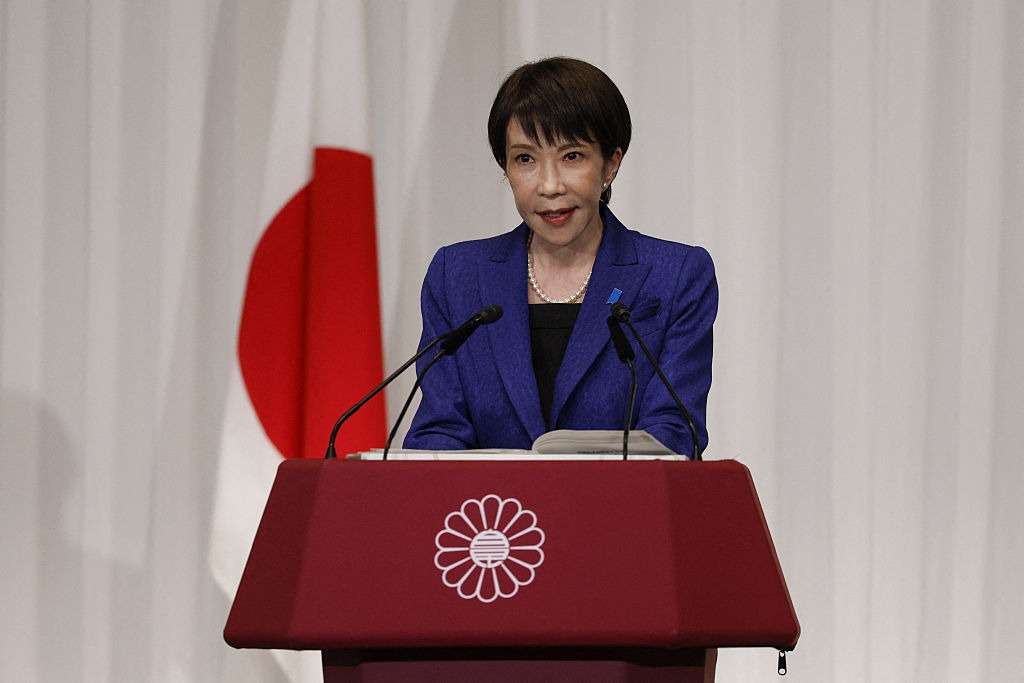
Nobody expected Prime Minister Sanae Takaichi to win so big in the Lower House election on 8 February. With her Liberal Democratic Party holding 316 of the 465 seats and its coalition partner, the Japan Innovation Party, securing another 36, this was an overwhelming victory that great prime ministers such as Yasuhiro Nakasone, Junichio Koizumi and Shinzo Abe could only dream of.
Given the significant gap between Takaichi’s approval ratings and her party’s, it is reasonable to conclude that many of her party colleagues were elected on the coattails of their leader.
But then there was China’s effect on the election, too. Abandoning its commitment to the peaceful settlement of the Taiwan Strait issue, it seems to be eager to eliminate any perceived block on its way to the forceful annexation of Taiwan. So it reacted vehemently to Takaichi’s November remarks to the Japanese parliament that hinted at the possibility of Japanese forces being dispatched to the Taiwan Strait under certain conditions.
While demanding loudly that Takaichi retract her remarks, China resorted to various kinds of coercion and intimidation. Its consul-general in Osaka shockingly posted on X that Takaichi’s ‘filthy neck will be chopped off without a moment’s hesitation’. The government in Beijing issued a solemn warning to tourists and students about the dangers of travelling to Japan. It also reintroduced a total ban on Japanese fish and seafood. Export restrictions on Chinese rare-earth and other products to Japan were implemented. Moreover, the history card was blatantly wielded once again, labelling Takaichi’s remarks as a resurgence of Japanese militarism.
Thus, the choice for the Japanese electorate in this election was either to heed China’s warnings and accept Japan becoming a minor power in the Sino-centric order, always second-guessing Beijing’s wishes and acting accordingly, or to stand firm and tall despite mean and egregious bullying. In other words, this election presented a watershed for Japan’s course as a nation over the next 10, 20 and even 50 years.
The results show that the Japanese public clearly chose to stand firm and tall, expressing full confidence in Japan’s hard-working first female prime minister.
The weight of this political development reverberated throughout Japan and beyond.
It was not only US President Donald Trump who gave overwhelming support and heartfelt congratulations. The list went on and on. Taiwan was engulfed in excitement.
In Australia, strategists must have learned from its dealings with China early this decade that not yielding in severe adversity is the most arduous yet most effective way to set things right. Stabilisation for the sake of temporary relief from pressure and myopic trade and investment gains cannot earn respect and may even undermine deterrence. Thus, strategically minded Aussies can find the best mate in Takaichi.
Importantly, Takaichi, in her policy statement to the parliament in October, mentioned the importance of the unity of Quad partners. In light of recent tensions between Washington and Delhi, there is much that Canberra and Tokyo can do, both jointly and separately.
Trilateral cooperation among Australia, Japan and the United States, as well as between Australia, Japan and the Philippines, should be further promoted. To maintain peace and prosperity in the Indo-Pacific, like-minded nations need to join forces to strengthen deterrence and enhance our capabilities to respond to contingencies.
The prevailing assertion that China’s economic slowdown and the disarray at the top echelon of the armed forces significantly decreased the likelihood of invasion might itself serve as an open invitation to China’s reckless adventurism across the Taiwan Strait.
Indeed, Chinese President Xi Jinping has already raised the stakes of Taiwan reunification too high by publicly proclaiming that it is an indispensable piece of the rejuvenation of the Chinese people. So we may assume he is placed in a position to have to take some action before his third term ends in 2027. The prevalence of weak and meek leaders in liberal democracies may only encourage his ambition. We ought to be more vigilant than ever.
In this regard, the upcoming March summit between Takaichi and Trump in Washington could be crucial, especially since it is immediately before Trump’s visit to China.
Closer coordination and unity would be critical to prevent China from underestimating our resolve and determination to maintain the status quo.
Words and rhetoric do not suffice. Increasing defence capabilities cannot wait.
Essential in strengthening Australia’s defence and Japan’s industry prowess is the program to equip the Royal Australian Navy with frigates of Japan’s improved Mogami design. This will also improve interoperability between the two defence forces.
Another priority of the Takaichi government and its coalition partner is to increase intelligence capabilities. With Andrew Shearer, formerly director general of the Office of National Intelligence, as its newly appointed ambassador in Tokyo, Australia is in the best position to help Japan advance steadily in this field.
Viewed this way, a strategically minded government with strong public support in Tokyo over the next few years presents a golden opportunity to promote the special strategic partnership between Australia and Japan.
About the Author