
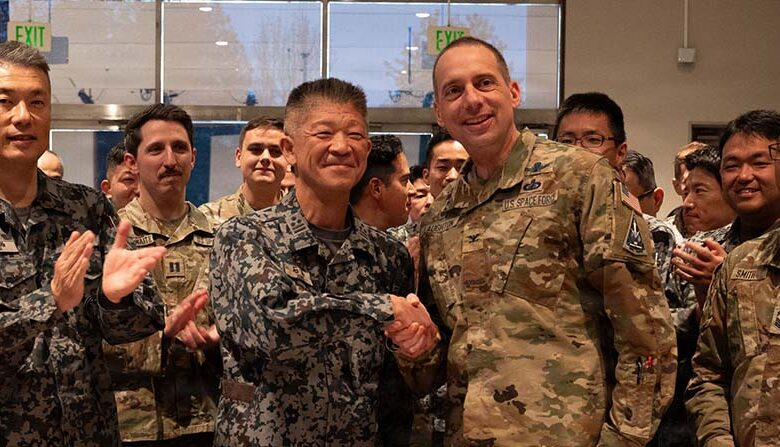
A year after its activation, United States Space Forces-Japan (USSF-J) has emerged as a vital pillar of the longtime Japan-U.S. alliance, deepening space integration at a time when the Indo-Pacific security environment is increasingly shaped by developments in orbit. The unit’s growing role highlights the evolving utility of space capabilities in deterrence, crisis response and multidomain interoperability.
The Japan-based component has expanded its operational capabilities, institutionalizing coordination with the Japan Air Self-Defense Force (JASDF) Space Operations Group and setting the groundwork for space to become a fully integrated domain of alliance planning and warfighting.
Growing regional threats, such as counterspace developments by China and Russia and North Korea’s missile provocations, lend urgency to initiatives to strengthen space-based missile warning, communications and domain awareness. The December 2024 activation of USSF-J followed the December 2022 establishment of a similar unit in South Korea, the first under U.S. Space Forces Indo-Pacific.
“Space is a central pillar of cross-domain operations,” John Jacobs, an analyst with Japan’s Network for Security Business and Technology (NSBT), told FORUM. “Effective satellite-based communications are especially an important prerequisite for ensuring superiority across land, sea, air, cyber and electromagnetic domains.”
USSF-J creates paths for tactical and strategic integration, according to Col. Ryan Laughton, component commander. “Space is becoming more and more contested,” and closer cooperation with Japan is essential as the domain increasingly resembles a warfighting environment, he told Japanese broadcaster NHK in late 2025.
Hiroyasu Harada, also with NSBT, noted the distinct strategic context of the Indo-Pacific. “Compared with Europe, where a relatively mature security architecture centered on NATO exists, the Indo-Pacific is characterized by a fluid, multipolar landscape of alliances,” Harada told FORUM. “Space is being used as a tool to shape the security order itself.”
This has spurred Tokyo to bolster its space capabilities. Japan’s Defense Ministry plans to restructure the JASDF into an Air and Space Self-Defense Force and establish a Space Operations Command in 2026, Jacobs said. The reorganization is designed to complement alliance efforts and better align with USSF-J, headquartered at Yokota Air Base, about 50 kilometers west of Tokyo.
Japan also is developing a constellation of small satellites for standoff defense, which is expected to enter operation by 2027. The system will provide near real-time intelligence, surveillance and reconnaissance and will integrate with U.S. assets for enhanced resilience.
USSF-J also has been pivotal in enabling space interoperability, Jacobs noted. A recent milestone was the launch of a U.S. space domain awareness sensor aboard a Japanese satellite using Japan’s H-3 launch vehicle — a demonstration of how the allies are leveraging shared infrastructure to close capability gaps.
“Interoperability can be understood as a condition in which military, civil and commercial actors are able to work together seamlessly on the basis of shared space infrastructure and common rules,” Harada said. “This three-layered structure allows space infrastructure to function not merely as a military tool, but as a common foundation.”
As the Japan-U.S. alliance addresses emerging counterspace threats, its expanding space partnership offers a model for regional partners seeking to build resilience across domains, analysts say.
Closer space integration “strengthens deterrence across air, sea, cyber and missile defense by signaling intent to develop capabilities to disrupt a range of multidomain threats,” Jacobs said.
About the Author