
In his annual address to French ambassadors in January, French President Emmanuel Macron sharply criticized the US for “gradually turning away” from some of its allies and “breaking free from international rules,” and rejected what he described as a “new colonialism and new imperialism,” the Agence France-Presse (AFP) reported.
Macron’s remarks have put the term “new imperialism,” or “neo‑imperialism,” squarely in the international spotlight, with many observers linking it to what some describe as a series of predatory actions by the current US administration. From the forcible seizure of Venezuelan President Nicolas Maduro, to renewed covetousness over Greenland’s resources, to prior threats of control over the Gaza Strip, and even startling suggestions about making Canada the US’ 51st state – within months of the new US administration taking office, criticism of its pursuit of a neo-imperialism has grown steadily louder.
The term itself is not novel. Debates surrounding the US neo-imperialism have existed since the end of the Cold War. However, under the hegemonic logic of “America First,” a string of rhetoric and actions by the current US administration has prompted the world to revisit the specter of new imperialism, producing widespread strategic anxiety and security concerns.
“America First” is now just imperialism, commented the Chicago Sun-Times on January 6. Against this backdrop, the Global Times is launching a series of articles to analyze, from multiple angles and dimensions, how the US’ new imperialism is manifesting today, and the severe dangers it poses to a multi-polar world. This first installment focuses on the US’ extractive, take-without-reciprocity “predatory diplomacy,” a stark expression of its new imperialism.
The US’ increasingly aggressive stance on Greenland seems to have left many on the other side of the Atlantic feeling uneasy.
US President Donald Trump has announced that, beginning February 1, a 10-percent tariff will be applied to all goods imported from Denmark, Norway, Sweden, France, Germany, the UK, the Netherlands, and Finland – rising to 25 percent on June 1 if no deal is reached – until the US purchases Greenland from Denmark, according to a BBC report on January 20.
The world watches as the US steps up its actions on the Greenland issue in recent days. The US government has openly signaled its interest in the island’s resources and has sought, by various means, to gain control of the territory, which has provoked sharp international criticism of US foreign policy.
The US “has embraced a transactional and predatory approach to foreign policy,” US political commentator David Frum had warned. And earlier in February 2025, public intellectual Francis Fukuyama condemned the US president for an “expansionist mindset” that had found expression in a “new American imperialism,” according to Australian online magazine Quillette.
Yet the Greenland issue is not an isolated incident. The public found that under the current administration, US diplomacy has taken on increasingly stark transactional – and even predatory – characteristics. From demanding that its allies “pay up” for security to openly eyeing foreign territory and strategic resources, this diplomacy operates under the banner of “America First,” pursuing unilateral pressure and the extraction of advantage – a pattern that some observers describe as “predatory diplomacy” or “extortionate diplomacy,” Li Haidong, a professor at China Foreign Affairs University, told the Global Times.
In a sharp critique of US foreign policy, Time Magazine labeled the US a “predatory regime” in its January 7 article titled “The Greenland Crisis Could Break NATO,” noting that “For Europeans, the US is now a predatory regime” amid fears over Washington’s aggressive push to control Greenland and pressure allies. Another Time magazine piece on January 16 cited a European survey, stating that the US’ “allies now worry about falling victim to a predatory US.”
This echoes Japanese commentator Hiroyuki Akita’s March 2025 Nikkei article, which labeled the US’ approach “predatory diplomacy,” depicting the US as “baring its fangs” to prey on weaker nations and allies unable to resist the dominant power.
An aerial photo shows the Nave Photon crude oil tanker, carrying a shipment of Venezuelan oil, docked in Freeport, Texas, on January 16, 2026. Photo: VCG
Predatory actions across the globe
Since taking office in early 2025, the current US administration carried out a series of predatory actions across the globe that spare neither its “allies” nor “foes,” laying bare the essentially predatory diplomacy at its core.
On January 14, Trump said on social media that “anything less” than US control of Greenland is “unacceptable.” Shortly thereafter, the US announced a 10-percent import tax starting in February on goods from eight European countries as mentioned earlier – a move that turned its covetousness of Greenland into an open threat. Dutch Foreign Minister David van Weel openly condemned the imposition of tariffs over the Greenland issue, calling it an act of “blackmail.”
The US’ military action against Venezuela in January and its subsequent forcible seizure of Venezuelan resources was another typical case. After the forcible seizure of Venezuela president on January 3, Trump claimed that the US would take control of the country’s massive oil reserves and recruit American companies to invest billions of dollars, and “start making money for the country,” CNN reported on the following day.
Apart from Greenland and Venezuela, the US has also openly expressed ambitions toward the territory or resources of areas such as the Gaza Strip, Panama Canal, Gulf of Mexico, and even Canada.
The current US administration appears to offer more limited support to its allies.
In June 2025, NATO leaders finally agreed to raise their defense spending to 5 percent of GDP, “following months of pressure” from the US, the BBC reported that month. That increase may lead to “sacrifices” within NATO member states, such as cuts to pensions, health, and security systems, Euronews reported.
Looking back, instances of the US practicing “new imperialism” are not unheard of, including the launch of the Iraq War under spurious pretexts. However, the current administration’s approach is even more nakedly exploitative, and makes little attempt to hide its intent to extract advantage.
This reveals a “law of the jungle” worldview held by the current US administration, in which the strong dominate the weak and the pursuit of national self-interest takes precedence over international rules and moral considerations, Li commented.
An Iranian woman walks past an anti-US mural on a street in Tehran, Iran, on January 3, 2026. Photo: VCG
Predatory tactics in multiple fields
The tactics and rhetorical arsenal the US deployed in implementing its predatory diplomacy have become more diverse and intricate, involving multiple fields including the economy, laws, and military forces.
On the economic and financial front, for instance, when Macron recently rebuffed the invitation to join Trump’s proposed “Board of Peace” for Gaza, the US administration once again brandished its tariff cudgel, claiming it would impose staggering 200-percent duties on French wines and champagnes to force compliance, according to Reuters.
Tariffs are frequently used as a tool in the US’ predatory diplomacy. The website of the White House showed that, under an agreement being reached in 2025, the US imposed a tariff rate of 15 percent on most European Union (EU) goods, and maintained tariffs of up to 50 percent on steel, aluminum, and copper, much higher than the average 1.2 percent of US tariff on imports from the EU in the previous year, according to investor advisory firm Capital Economics.
Li told the Global Times that the US administration’s across-the-board, tariff-driven policies have seriously damaged the established operating rules of economic globalization.
Li also mentioned that, on the legal plane, the Trump administration operates according to a stark “might makes right” logic – where raw power, not principle, dictates how rules are written and enforced. This philosophy finds its most vivid expression in the sophisticated “packaging” of law and public narrative: The criminalization of targeted leaders – such as Maduro – through indictments, the strategic affixation of incendiary labels such as “narco-terrorism” or “drug kingpin,” and the weaponization of these charges to cloak geopolitical maneuvers in the garb of justice.
Song Zhongping, a Chinese military affairs expert, told the Global Times that the so-called “decapitation operation” – a swift military strike by the US that seized Maduro in early January – laid bare a third dimension of the administration’s “predatory diplomacy” approach: The military realm.
According to Song, this predilection has manifested with striking clarity, not only in the “lightning raid” on Venezuela, but also in earlier actions against Syria, repeated interventions across the Middle East, and the broader pattern of kinetic operations framed as decisive solutions to complex geopolitical challenges.
Bring anything but ‘peace’
Nonetheless, some voices within the US have sought to whitewash the government’s transactional and even predatory diplomacy, claiming that such a strategy can “bring more peace.”
But such kind of whitewashing and truth-inverting viewpoint is being widely refuted.
Even before any military action against Venezuela was launched, in an open letter in late 2025, left-wing European politicians including former Labour leader Jeremy Corbyn, Greece’s former Finance Minister Yanis Varoufakis and Labour MP Richard Burgon, wrote “if the US launches a military intervention in Venezuela, it would mark the first interstate war by the US in South America.” The letter mentioned how past US military operations in Latin America linked to the “war on drugs” had “delivered not security but a torrent of bloodshed, dispossession, and destabilization,” according to the Guardian.
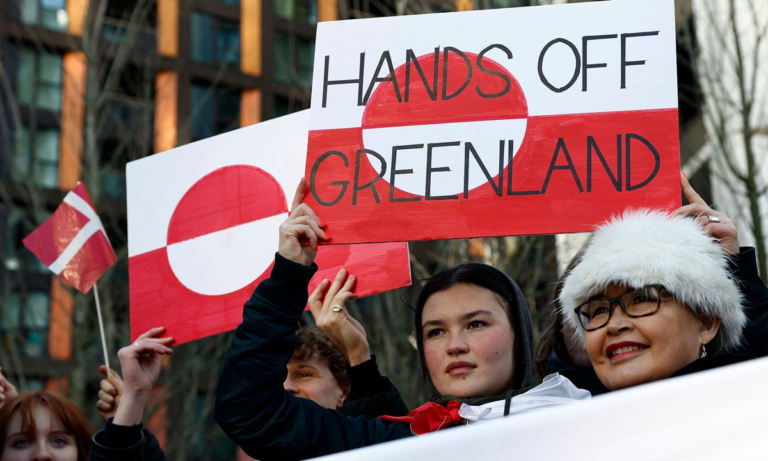
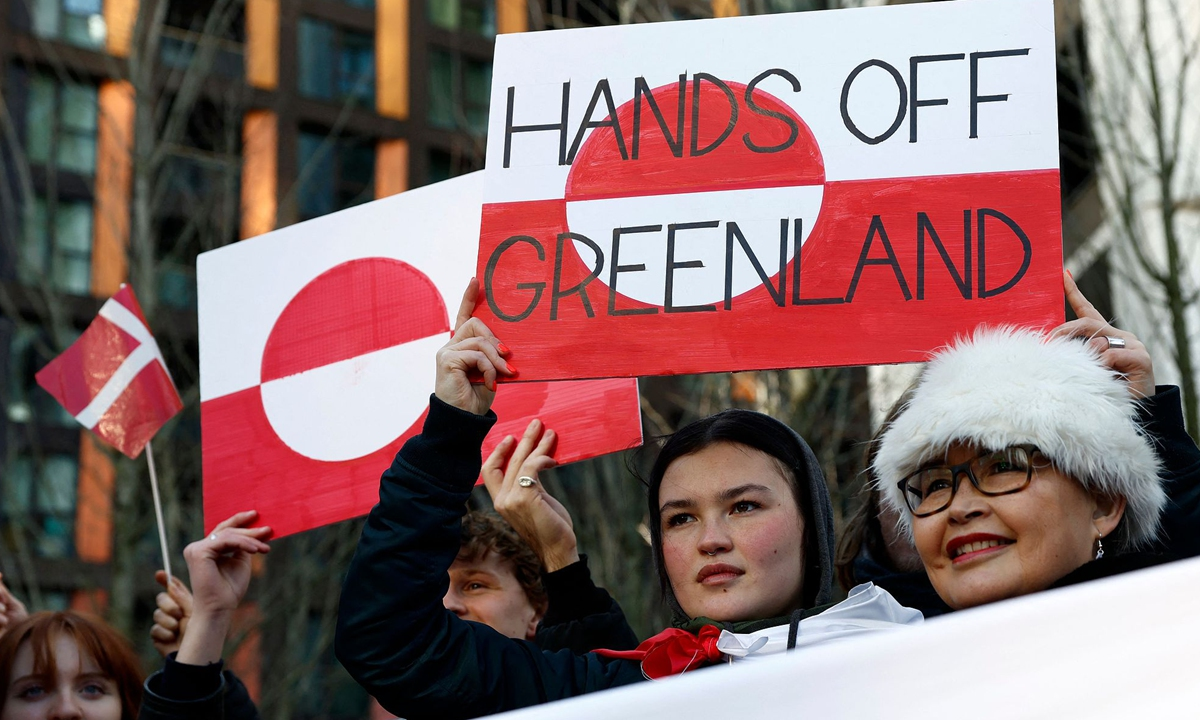
For people in the involving areas, the US’ transactional and predatory diplomacy has brought anything but “peace”; it has instead engendered deep concern and widespread panic. Recent protests reportedly to have swept across Greenland and Denmark, with thousands rallying in Nuuk, Aasiaat, Qaqortoq, Ilulissat, Copenhagen, and other cities against the US administration’s push to acquire Greenland, chanting slogans like “Greenland is not for sale” and “Hands Off Greenland.”
Li criticized that the US’ predatory diplomacy is inflicting serious harm worldwide, causing loss of life and property, exacerbating regional tensions, and undermining the foundations of the international order.
“Disregarding the voices of other countries’ people, and acting on the belief that sheer power allows one to do whatever it wants and force others to submit – isn’t that new imperialism?”
About the Author