
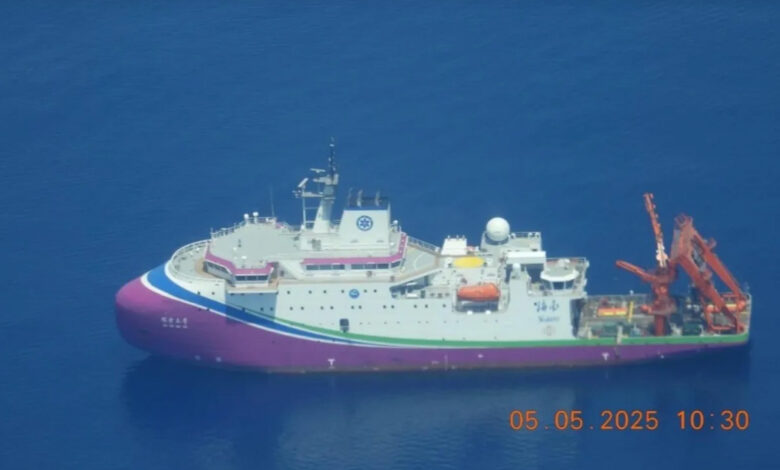
Five Chinese Communist Party (CCP) research vessels, including ships used for space and missile tracking and underwater mapping, were active recently in the northwest Pacific Ocean, a Guam-based research group reported in late November 2025. The vessels’ activity over 90 days coincided with United States-led defense exercises in the region and amplified suspicions that CCP science vessels conduct military assignments.
Three CCP vessels, including the space and missile tracking ship Yuan Wang 7, were tracked near the island nation of Kiribati, according to the Pacific Center for Island Security. Kiribati in 2019 switched its diplomatic allegiance to China from Taiwan, the self-governed island that the CCP threatens to annex by force.
Two additional CCP research vessels traveled east of the U.S. territory of Guam, near the Federated States of Micronesia and the Marshall Islands. Both countries are covered by Compact of Free Association agreements in which the U.S. is responsible for their defense.
The U.S. and its Allies and Partners have conducted military drills near Guam in recent months. Exercise Malabar, with Australia, India, Japan and the U.S. conducting anti-submarine and air defense training, concluded in mid-November. The monthlong Exercise Silent Shark, a Republic of Korea-U.S. anti-submarine drill near Guam, continues until mid-December.
“Is the fact that the Chinese are sending research vessels into this area to map what is effectively undersea battle space surprising? Probably not.” Leland Bettis, the research group’s director, told the Reuters news service.
Guam and Micronesia are part of the second island chain, a line of defense against potential CCP military aggression; the first island chain stretches from Japan to the Philippines.
Under the guise of marine research, the CCP’s fleet of scientific vessels can provide the People’s Liberation Army Navy (PLAN) with undersea mapping and other critical data.
More than 80% of China’s 64 active marine research vessels demonstrated suspect behavior or were tied to advancing Beijing’s geopolitical agenda, the Center for Strategic and International Studies (CSIS), a U.S.-based think tank, reported in 2024.
Dozens of countries have oceanographic research programs, which contribute to global efforts to study marine life, geology and the distribution of natural resources, CSIS noted.
The United Nations Convention on the Law of the Sea gives coastal states the right to regulate such research within their respective 200-mile exclusive economic zone (EEZ). CCP vessels, however, have intruded into nations’ EEZs without permission. In May 2025, for instance, the Philippine Coast Guard said there was clear evidence that Beijing was “conducting illegal marine scientific research activities” within the Philippines’ EEZ and “lacking the legal authority to undertake such activities in this area.”
Some CCP vessels repeatedly provide false identification or disable their automatic identification system for extended periods. Such activities are red flags and occur frequently, sometimes near other nations’ military facilities, CSIS said.
In the northwest Pacific, the CCP ships have been studying waters that the PLAN considers strategically vital, including off Taiwan’s east coast and about 400 kilometers east and west of Guam, The New York Times reported in July 2025.
The U.S. considers the region “essential to maintaining a stable, secure, and free Indo-Pacific,” a Department of War spokesperson told Newsweek. “We continue to work closely with partners there to strengthen cooperation, improve infrastructure and logistics, and enhance maritime domain awareness. Our focus remains on supporting our partners’ sovereignty and ensuring the region remains peaceful, resilient, and free from coercion.”
About the Author