
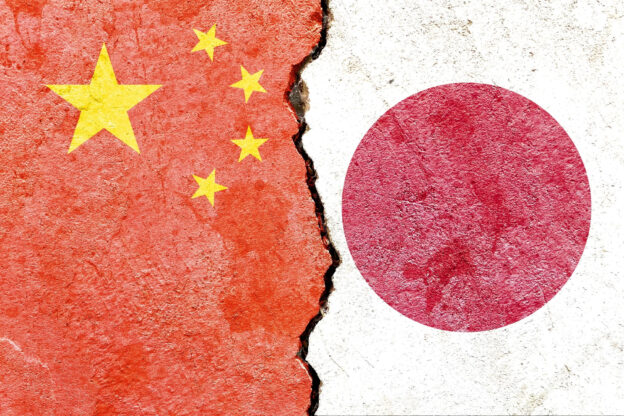
China is exploiting Japanese Prime Minister Takaichi Sanae’s recent remarks on a potential Taiwan contingency to ramp up pressure on Tokyo, at a time when Japan is accelerating efforts to reinforce its defense posture vis-à-vis Beijing.
In particular, Beijing is intensifying its use of the so-called “Three Warfares” (三战) against Japan – namely, public opinion warfare (舆论战), psychological warfare (心理战), and legal warfare(法律战)– forms of strategic information and political operations aimed at advancing national objectives without resorting to military force.
Rooted in famous ancient strategist Sun Tzu’s principle of winning without fighting, the “Three Warfares” doctrine is carried out not only by the People’s Liberation Army but also across China’s entire state apparatus, underpinning nationwide efforts to shape narratives and promote its foreign policy goals.
The Three Warfares were adopted in 2003 by the Chinese Communist Party Central Committee and the Central Military Commission, and were entered into the Peoples’ Liberation Army Political Ordinance.
If countries understand this doctrine, they will be better positioned to anticipate the Chinese government’s behavior when problems occur.
Public opinion warfare aims to bolster morale inside of China while shaping narratives that weaken the enemy’s will to fight. Media and information outlets – including newspapers, books, radio, television, the internet, and even email – are all regarded as operational tools. Public opinion warfare has become a highly effective weapon for Beijing, given the asymmetry in freedom of expression between China and Japan.
In a recent row with Japan, China’s Foreign Ministry claimed last month that a series of crimes targeting Chinese nationals had occurred frequently in Japan, urging Tokyo to ensure their safety and advising Chinese citizens to refrain from traveling to Japan.
In response, Japan’s Foreign Ministry released actual figures on crimes such as murder, robbery, and arson in which Chinese nationals were victims, refuting Beijing’s claims of deteriorating public safety in Japan. “Such assertion is incorrect,” Japan’s Foreign Ministry stated.
Despite the fact that Beijing’s claims are unfounded, thanks to China’s active dissuasion, hotel reservations by Chinese tourists visiting Japan plunged by 57 percent between November 21 and November 27 compared with November 6 through November 12, Nikkei Asia reported on December 3.
Furthermore, China has taken its claims to the international stage. It has sent two separate letters to U.N. Secretary-General Antonio Guterres, accusing Takaichi of making blatantly provocative remarks about Taiwan.
Meanwhile, Japan has also sent a letter to Guterres rebutting China’s narratives. The letter states that China’s claims “appear to be inconsistent with the facts and unsubstantiated.”
In the letter, Japan’s ambassador to the United Nations, Yamazaki Kazuyuki, stressed that Japan’s defense posture is fundamentally and exclusively defense-oriented – contrary to Beijing’s assertions – and that Japan’s domestic laws strictly limit the circumstances under which the right of collective self-defense, as recognized under the U.N. Charter, may be exercised.
Yamazaki noted that Takaichi’s remarks were fully in line with this position, arguing that “China’s assertion that Japan would exercise the right of self-defense even in the absence of an armed attack is erroneous.”
In any case, those letters will be circulated to all U.N. member states as an official document of the General Assembly, with China amplifying Takaichi’s remarks on Taiwan on the international stage. By advancing its narrative at the United Nations, China is seeking to sway international opinion to its side and undermine Japan’s support base.
In addition, China has launched an information warfare campaign through media commentaries questioning Japan’s sovereignty over Okinawa. In response, Japan’s Chief Cabinet Secretary Kihara Minoru dismissed Beijing’s assertions, saying, “I do not believe there is any need to comment on Chinese reports, because there is absolutely no doubt that Okinawa is part of Japan’s sovereign territory.”
Meanwhile, China is also suppressing any rival narratives. Former Global Times editor-in-chief – and noted nationalist – Hu Xijin criticized a November 28 incident in Shanghai where Japanese singer Otsuki Maki, known for performing a theme song for the anime “One Piece,” was abruptly cut off mid-song. The lights went out and she was escorted offstage. On November 29, Hu posted on social media where he criticized the handling as “rude” and “excessive” and warned against conflating Japanese people with the Japanese government or its right-wing.
The Chinese authorities reportedly deleted Hu’s post.
Psychological warfare seeks to break the adversary’s resolve to resist.
Most notably, on November 24, Chinese President Xi Jinping held a telephone call with U.S. President Donald Trump. According to China’s Foreign Ministry, Xi outlined China’s principled position on the Taiwan issue. It added that Trump said the United States understands “how important the Taiwan question is to China.”
By reaffirming that Taiwan is an inseparable part of China’s territory, Xi effectively cautioned the United States against interfering in the matter and clearly sought to drive a wedge between Japan and the United States. This amounts to psychological pressure on Japan.
Legal warfare – also called “lawfare” – provides legal authority to public opinion warfare and psychological warfare.
Takaichi said in the Diet on November 26 that “having renounced all rights and claims under the Treaty of San Francisco, we are not in a position to recognize Taiwan’s legal status.”
In response, China’s Foreign Ministry asserted that the San Francisco Peace Treaty was “illegal and invalid.”
The ministry’s spokesperson said that Takaichi “deliberately chose not to mention the Cairo Declaration and the Potsdam Proclamation – two international legal documents with full effect and underscored in the Sino-Japanese Joint Statement and the Sino-Japanese Treaty of Peace and Friendship.”
“These documents, all bearing the force of international law, have formed the complete legal basis for China’s recovery of Taiwan,” China’s People’s Daily reported on December 1, adding “any erroneous claim of an ‘undetermined status of Taiwan’ constitutes a blatant challenge to the post-war international order.”
China is mounting a nationwide campaign against Japan that combines the “three warfares” – public opinion warfare, psychological warfare, and legal warfare. The recent controversy surrounding Takaichi’s remarks on a Taiwan contingency has drawn attention to concepts such as Japan’s definition of a “survival-threatening situation,” which remains poorly understood outside the country.
To counter Beijing’s messaging, the best thing the Japanese government can do is to actively communicate its position in multiple languages – not only Japanese, but also English, Chinese, Spanish, French and others. Relying solely on Japanese is ineffective; no one will thoughtfully translate and disseminate Japan’s arguments on its behalf. Out of the world’s 8.2 billion people, only a little over 100 million can understand Japanese.
About the Author