
China would defeat the US military in a war over Taiwan, according to a top-secret US government assessment.
US reliance on costly, sophisticated weapons leaves it exposed to China’s ability to mass-produce cheaper systems in overwhelming numbers, the highly classified “Overmatch Brief” warns.
A national security official under Joe Biden who reviewed the document is said to have turned pale on realising Beijing had “redundancy after redundancy” for “every trick we had up our sleeve”, The New York Times reported.
Losing Taiwan, the US’s key bulwark against Chinese power in the western Pacific, would deliver a severe strategic and symbolic blow to Washington.
The country’s most advanced aircraft carrier, the USS Gerald R Ford – recently sent to the Caribbean for Donald Trump’s crackdown on drug traffickers – is often destroyed in the wargames outlined in the brief.
The $13bn (£9.75bn) vessel, which entered service in 2022 after years of delays, is vulnerable to attacks from diesel-electric submarines and China’s arsenal of some 600 hypersonic missiles, capable of travelling at five times the speed of sound.

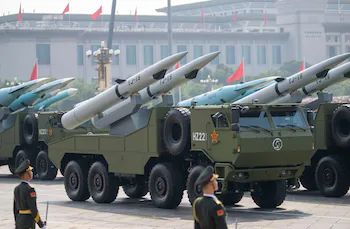
Beijing displayed its ship-destroying YJ-17 missiles, estimated to travel at eight times the speed of sound, at a military parade in September.
Nevertheless, the Pentagon is planning to build nine additional Ford-class aircraft carriers, while it has yet to deploy a single hypersonic missile.

Eric Gomez, a research fellow at the Taiwan Security Monitor, said the end result was unclear when he participated in a wargame for a Taiwan conflict, but noted the US suffered heavy losses.
“The US loses a lot of ships in the process. A lot of F-35s and other tactical aircraft in the theatre are degraded pretty rapidly too,” he told The Telegraph.
“I think the high cost of it was really sobering when we did the after-action summaries, and we’re like, ‘Okay, like, you guys lost 100-plus fifth-generation aircraft, multiple destroyers, a couple of submarines, a couple of carriers’.
It’s like, ‘oh gosh, man, that was a heavy toll’.”
Hegseth: China could destroy US carriers in minutes
Last year, Pete Hegseth, the defence secretary, said that “we lose every time” in the Pentagon’s war games against China, and predicted the Asian country’s hypersonic missiles could destroy aircraft carriers within minutes.
China has significantly expanded its arsenal of short, medium, and intermediate-range missiles, which means it could destroy many of the US’s advanced weapons well before they could reach Taiwan.
Meanwhile, the “big five” defence companies, a number which has dwindled from ten times that amount in the 1990s, continue to sell the US government costlier versions of the same ships, aircraft and missiles, according to The New York Times.
Defence officials have realised the US is vulnerable because these complex weapons are impossible to mass produce, following a series of recent wars, including the Ukraine-Russia conflict, which have shown the devastating capabilities of relatively cheap weapons like drones.
Congress has earmarked around $1bn (£750m) to produce 340,000 small drones over the course of the next two years.

Mr Trump has appointed Dan Driscoll, the US head of the armed forces, as his “drone guy,” charged with modernising America’s outdated tech and countering enemies’ drone efforts.
However, the US is nevertheless playing catch-up with its adversaries, and experts have previously told The Telegraph that it cannot compete on costs with countries like China, where labour costs are lower and regulations looser.
A decisive change in US policy would likely need substantial investment, yet defence spending is at its lowest level in around 80 years, at roughly 3.4 per cent of GDP.
Jake Sullivan, the former national security adviser, has warned the US would quickly run out of essential munitions like artillery shells in a war with China.
Internal Pentagon assessments show China vastly outnumbers the US in its arsenal of almost all cruise and ballistic missiles. Both superpowers maintain a stockpile of 400 intercontinental ballistic missiles (ICBMs).
About the Author