
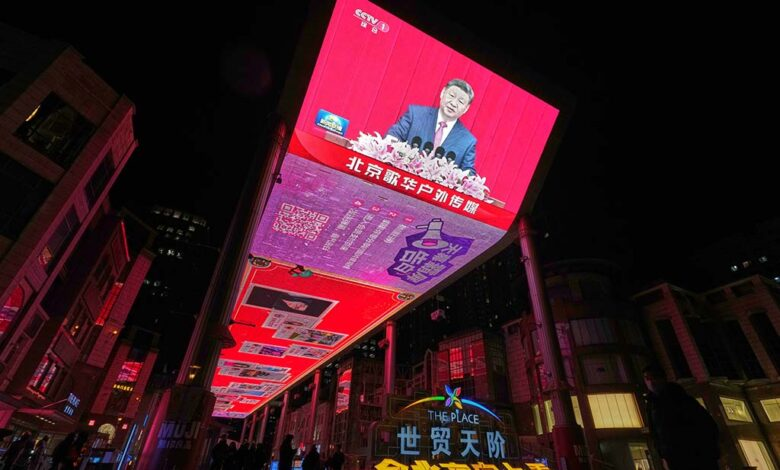
Chinese Communist Party (CCP) General Secretary Xi Jinping is ushering in a new century of shame for his country, a growing number of security experts contend. Instead of restoring China’s dignity, sovereignty and greatness, as Xi promises in his rhetoric, he may be undermining its strength anew.
Security analysts and government experts increasingly view Xi’s strategy as rigid and prone to miscalculation. Their core contention: Xi’s interpretation of the so-called century of humiliation is shaping foreign policy in ways that heighten the risk of crisis, isolation and failure.
The century of humiliation narrative, a key component of CCP propaganda, describes the period in Chinese history from the mid-19th to mid-20th centuries that ended with the creation of the People’s Republic of China (PRC) as a time of national embarrassment when colonial powers dominated China.
Since coming to power in 2012, Xi has weaponized the narrative to justify CCP rule and his legitimacy, layering on a promise of “national rejuvenation” by 2049. He has tied this mission to resolving the issue of Taiwan, the self-governed island that China claims as its territory and threatens to seize, raising the stakes of miscalculation. He has elevated Taiwan to the most important unresolved vestige of the humiliation era, one the CCP considers nonnegotiable.
Evidence is mounting that an overconfident Xi is engaging in overreach and misinterpreting global trends. He believes that China, with partners such as a revisionist Russia, can redefine the world order. Russia already faces global sanctions and suspicion over its war against Ukraine.
Xi’s misperceptions may lead him to take excessive risks that end in military defeat and/or economic isolation. In the meantime, he has underestimated the strengthening of Indo-Pacific alliances, a growing chorus of experts contend.
“PRC writings on controlling escalation exhibit a number of persistent blind spots with alarming implications. … These blind spots could cause Beijing to become overly confident in the PLA’s [People’s Liberation Army] ability to control escalation in a crisis or conflict,” Alison Kaufman, a principal research scientist with the U.S.-based Center for Naval Analyses’ China and Indo-Pacific Security Affairs Division, wrote in a 2023 book for the National Bureau of Asian Research.
Beijing believes it can control all facets of military escalation, according to Lyle Morris, a senior fellow on foreign policy and national security at the Asia Society Policy Institute’s Center for China Analysis. China’s military strategists believe that if a crisis breaks out, “escalation can be ‘managed’ by applying scientific principles and advanced military technology,” Morris wrote in a January 2025 article for the U.S.-based think tank.
“This could make China’s leaders overconfident in their ability to prevail in a conflict and increase the risk of escalation in a military confrontation,” Morris wrote.
However, “an actual crisis or wartime situation will involve a complex and nonlinear interaction of these and other factors, including mistakes and accidents, that can be very difficult to control,” according to a May 2025 analysis by the U.S.-based Rand Corp. that identified 15 risk factors of escalation.
Under Xi, Beijing frequently restricts trade, tourism and market access as a weapon against states that resist its demands. But such coercion, along with aggressive rhetoric and public humiliation of foreign officials, is counterproductive, driving coalition-building among China’s targets.
At the same time, Xi is restricting the development of China’s resilience by centralizing power, limiting policy correction and subduing private sector dynamism, while alienating potential partners through aggressive diplomacy and coercion.
His intransigence echoes that of China’s Qing dynasty, which ended in 1911 after clinging to central authority, resisting reform and responding with rigid defensiveness, which invited further foreign intervention and internal revolt.
This combination of overconfidence, coercion and structural weakness increases the risk of a major strategic failure — war, economic crisis or systemic stagnation under external pressure. Ironically, Xi is structuring China’s domestic and external posture in ways that could make a new, long-lasting period of humiliation far more likely.
About the Author