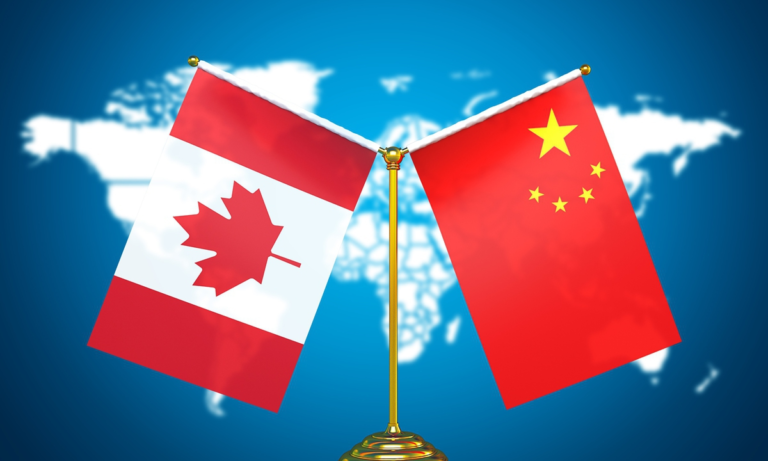


British Prime Minister Keir Starmer called China a security threat this week, but analysts said the statement was motivated by domestic politics and did not negate London’s goal of deepening economic ties with Beijing.
Meanwhile, disputes around a new Chinese embassy are expected to continue to test this desire for stronger relations as the British leader plans a state visit.
Starmer said on Monday that his government would focus on the relationship with China, which would help protect national interests, while recognising the “reality” that China posed “real national security threats” to the United Kingdom.
“Protecting our security is non-negotiable,” Starmer said at a banquet traditionally used to set out foreign policy for the year ahead, calling it “our first duty”.
“But by taking tough steps to keep us secure, we enable ourselves to cooperate in other areas,” he said.
The prime minister’s statement was the latest in a series of assertions about China being a security threat. These statements have received strong pushback from Beijing, which urged London to adopt a more constructive and accurate view of bilateral relations.
MI5 espionage fears over planned Chinese embassy
On Tuesday, Britain delayed for a third time its decision on China’s contentious plan to build a massive new embassy in London. Critics fear the project, which would be the largest embassy in Europe, could serve as a base for espionage.
Last month, Britain’s domestic spy service, MI5, warned lawmakers that Chinese intelligence services were posing as recruiters to target people working in parliament.
In a rare move, the agency identified two LinkedIn profiles under the names Amanda Qiu and Shirly Shen as being linked to Chinese intelligence.
In October, prosecutors abruptly abandoned a case against two British men charged with spying for Beijing, claiming that the government’s evidence was missing a “critical element”.
The Chinese embassy has repeatedly denied the espionage accusations, calling them “pure fabrication”.
It has also rejected Starmer’s “erroneous” characterisation of a “China threat”, asserting instead that China’s development would only bring opportunities globally.
“The UK should have a clear understanding of the situation, adjust its mindset, adopt a rational and friendly approach towards China’s development, pursue a positive and pragmatic policy towards China, and work with China in the same direction to steer China-UK relations onto a path of sound and steady development,” the embassy said on Tuesday.
Observers noted that Starmer’s choice of words was not surprising and mainly served a domestic purpose.
“There are things that both sides find it important to say in public. But I think it does not affect the ongoing substance of the [bilateral] dialogue,” said Andrew Cainey, senior associate fellow at the Royal United Services Institute.
Tim Summers, an assistant professor at the Chinese University of Hong Kong’s Centre for China Studies, said domestic politics was the main reason Starmer made the speech.
“He’s feeling weak and insecure, and therefore, by saying this, he tries to fend off criticism from those, and there’ll be many of them, who will criticise him simply for going to China,” Summers said.
Those thoughts was echoed by Zeng Jinghan, an international affairs professor at City University of Hong Kong.
“The real focus of the issue now is whether the so-called threat has escalated to a state-level concern – to the point where China could be defined as an adversary,” Zeng said.
“As long as Starmer does not do so, all the other rhetoric is merely a form of appeasement, a play on words,” he said.
UK’s Labour party still aims to re-engage with Beijing
Despite internal divisions over Britain’s China policy, the ruling Labour Party still aims to advance a distinct approach and re-engage with Beijing – a goal it has maintained since taking office last July and reiterated in Starmer’s recent speech.
At the Monday event, Starmer said Britain’s policy towards China could not continue to blow “hot and cold”, and failing to navigate bilateral ties would be “dereliction of duty”.
“We had the golden age of relations … which then flipped to an Ice Age, that some still advocate.”
“It’s time for a serious approach, to reject the simplistic binary choice,” he said, stressing that the scale of the opportunity in China was “immense”.
The prime minister plans to visit Beijing and Shanghai in late January, with a trip tentatively scheduled for January 29 to 31, though the dates have not been finalised, according to Bloomberg, which cited sources familiar with the matter.
If confirmed, Starmer would be the first British prime minister to visit China in seven years.
Ties between London and Beijing have deteriorated significantly over the crackdown on anti-government protests in Hong Kong, allegations of espionage and cyberattacks, and Beijing’s close relations with Russia.
The approval of the new Chinese embassy in London stands as a key symbolic test of the British government’s commitment to improving relations with China, according to observers.
“If London can approve the plan, the presence of a Chinese embassy there would instil strong confidence in many Chinese enterprises,” Zeng said.
About the Author