
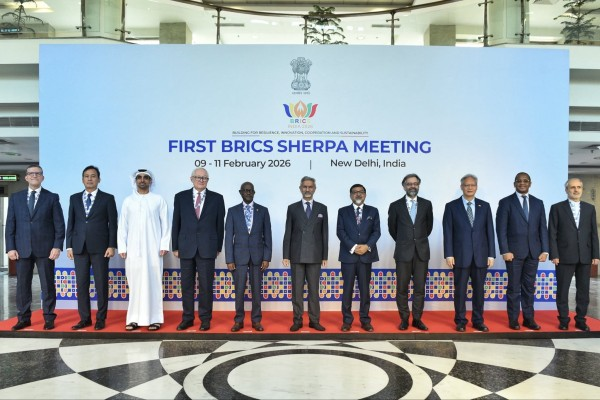
India has formally set the direction for its 2026 chairship of BRICS by hosting the first Sherpas and Sous Sherpas meeting in New Delhi on February 9–10.
This marks the operational start of its fourth term at the helm of the grouping and its first since BRICS expanded to include new members from West Asia and Africa.
The two-day meeting focused on India’s chairship theme, “Building for Resilience, Innovation, Cooperation and Sustainability.” Indian officials presented a structured roadmap covering economic coordination, climate action, food and energy security, technology partnerships and institutional reform.
Discussions also addressed cooperation in health systems, agricultural resilience, labour mobility, disaster risk reduction, climate and environmental frameworks, energy transition, digital innovation and counter-terrorism coordination, alongside financial and economic governance reforms.
A key element of the deliberations was strengthening BRICS’ internal processes, reflecting an emphasis on institutional consolidation as the grouping adapts to its expanded format.
India also positioned its chairship as people-centric, proposing enhanced engagement through the BRICS Academic Forum, Think Tank Council, Civil Forum, Business Council and Women’s Business Alliance. Youth, sports and cultural exchanges were highlighted as additional avenues to build societal linkages alongside state-level cooperation.
Secretary (Economic Relations) and India’s BRICS Sherpa Sudhakar Dalela said during the discussions that India’s approach would remain anchored in inclusivity and development-driven cooperation.
Sherpas and country representatives also called on External Affairs Minister Dr S. Jaishankar, who reflected on the evolution of the grouping as it completes 20 years. Jaishankar said BRICS has emerged as a valuable forum for international cooperation, consultation and coordination, advancing a people-centric agenda.
Member countries expressed alignment with India’s priorities. China’s Vice Foreign Minister Ma Zhaoxu conveyed Beijing’s support for deepening cooperation in innovation and green technologies, while emphasising the importance of multilateral coordination and people-to-people exchanges.
Belarus, attending the Sherpas’ meeting for the first time as a BRICS partner country, expressed interest in contributing technological expertise in food and water security.
Ambassador Mikhail Kasko conveyed confidence on behalf of President Aleksandr Lukashenko that India’s chairship would strengthen BRICS’ global standing. The Belarusian side also indicated its interest in joining the BRICS New Development Bank.
Russia indicated that it views BRICS as playing an expanding role in global economic and diplomatic coordination, with expectations linked to India’s leadership during its chairship year.
The Sherpas agreed to maintain regular consultations through the year to streamline deliverables ahead of the 18th BRICS Summit. The New Delhi meeting served to align priorities, define thematic tracks and initiate preparations for leaders’ engagement later in the year.
BRICS currently comprises Brazil, Russia, India, China, South Africa, Egypt, Ethiopia, Indonesia, Iran, Saudi Arabia and the United Arab Emirates. India, a founding member of the grouping, previously chaired BRICS in 2012, 2016 and 2021 and is leading the expanded format for the first time in 2026.
About the Author