
In an age of uncertainty, with global tensions at the brink of war, Indo-Pacific partners are “renewing their resolve” by strengthening their defense capabilities and industries, Japan’s defense chief told more than 400 military, government and industry leaders during the 2026 Honolulu Defense Forum.
“It is the responsibility of a defense community to connect this new dynamism,” Japanese Defense Minister Shinjiro Koizumi said. “We will link each nation’s independent efforts like a web, enhance connectivity and generate synergy.”
Such alliances and partnerships are “our strategic center of gravity,” Adm. Samuel J. Paparo, Commander of U.S. Indo-Pacific Command, said during his keynote address. “When we operate with Allies and Partners, we multiply capability. We raise the threshold for aggression.
“We’re continuing to strengthen our alliances and our partnerships, expanding our posture, and accelerating advanced capabilities, integration and interoperability because deterrence constantly demands visible capability and credible will,” Paparo said. “And we’re continuing to build the connective tissue that enables the joint force and our Allies and Partners to move together at speed across the largest, most consequential theater on Earth.”
The mid-January event hosted by Pacific Forum, a Hawaii-based think tank, had the theme “Operationalizing Indo-Pacific Readiness and Deterrence.” Topics included artificial intelligence, integrated air missile defense, expansionism, hybrid threats such as cyber and space, and multidomain deterrence capabilities.
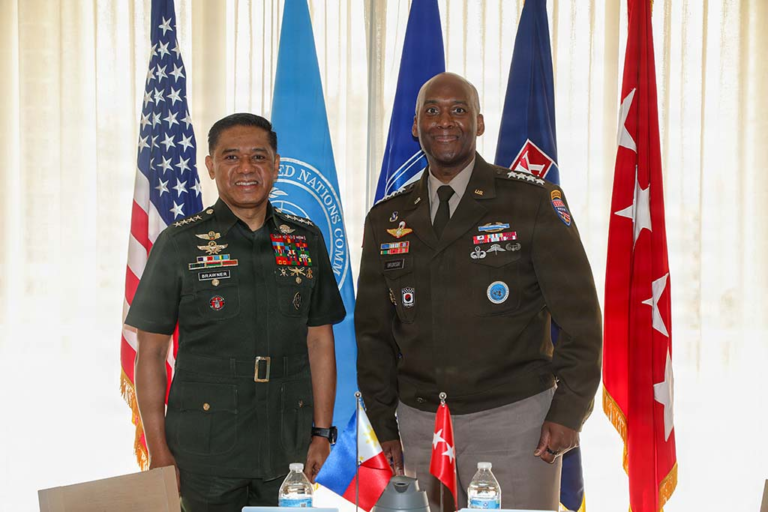
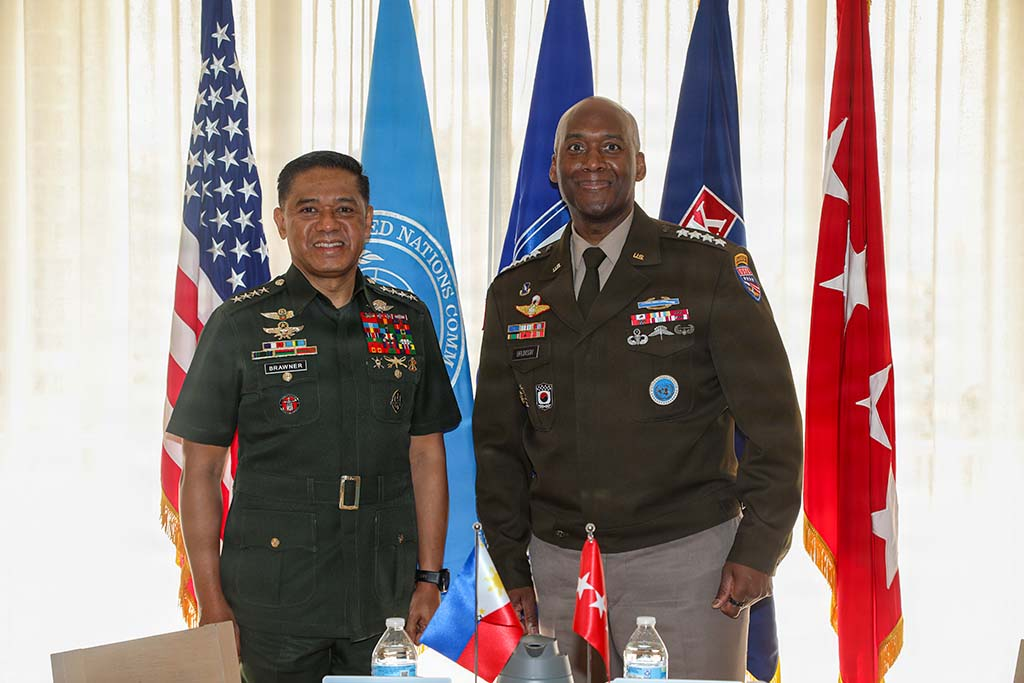
Among the panelists were Palauan President Surangel Whipps Jr.; Gen. Hiroaki Uchikura, chief of staff of Japan’s Joint Staff; Armed Forces of the Philippines chief Gen. Romeo Brawner Jr.; and U.S. Forces Korea commander Gen. Xavier T. Brunson.
Brawner highlighted China’s expansionist and destabilizing moves in the South China Sea, including in the Philippines’ internationally recognized exclusive economic zone. Beijing claims much of the resource-rich sea in defiance of a 2016 international tribunal ruling that invalidated China’s arbitrary territorial assertion.
In response, Manila is enhancing relationships, particularly with its longtime ally, the U.S. “We’re strengthening our partnership, and we’re doing more activities together like joint exercises, joint trainings, joint sails in the South China Sea in the spirit of freedom of navigation,” Brawner said, according to Hawaii News Now.
Koizumi warned that provocative military activities are intensifying across the region.
“Neighboring nations continue opaque military buildups and the regional military balance is shifting dramatically and rapidly,” he said. “Attempts to change the status quo by force continue in the East China Sea and the South China Sea.”
With the weaponization of economies, technology, resources, information and cyberspace, “the boundary lines between peacetime and contingency, between military and nonmilitary, between truth and fake news — these are no longer clearly visible,” he said.
“We must confront this reality head on and ensure peace and stability in the region.”
Koizumi noted that 2026 marks the 75th anniversary of the signing of the Japan-U.S. security treaty.
“The Japan-U.S. alliance is stronger than at any point in history,” he said. “The defense capabilities of both nations and of the alliance itself have been, and will continue to be, a powerful driving force for peace and prosperity in the Indo-Pacific region and the world.”
Paparo cited trends “reshaping modern conflict,” including information technology and the proliferation of uncrewed systems.
“We’ll continue to possess military advantage to prevail in competition, in crisis and in conflict, and will further integrate with Allies and Partners in dynamic relationships and security frameworks that bolster our respective national sovereignty,” he said.
“We are resolute on preserving a Free and Open Indo-Pacific where sovereignty holds, coercion fails and disputes resolve peacefully.”
About the Author