
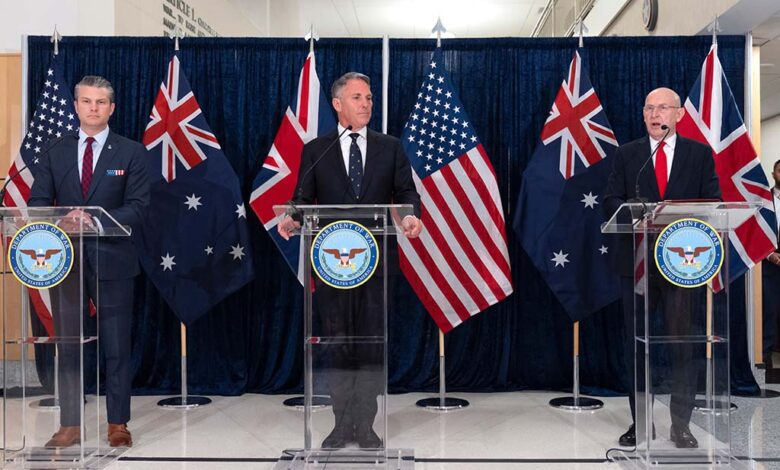
Defense leaders from Australia, Japan, the United Kingdom and the United States strengthened alliances and partnerships as they bolstered Indo-Pacific security and stability during December 2025 talks.
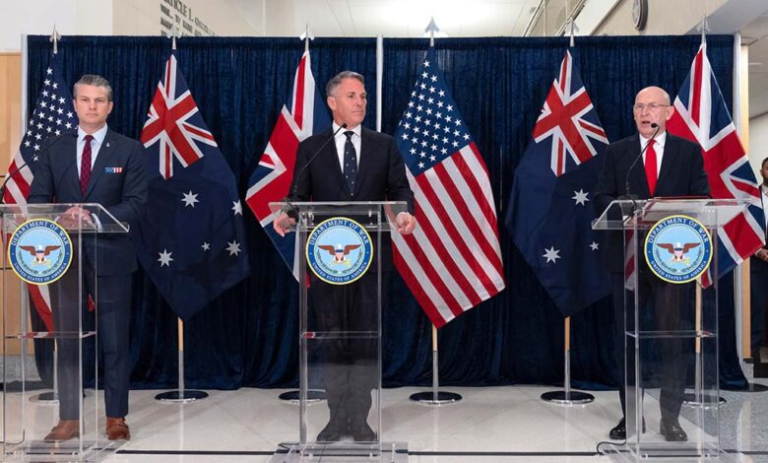
For the 40th Australia-U.S. Ministerial Consultations (AUSMIN) in Washington, D.C., Australian Defence Minister Richard Marles and Foreign Minister Penny Wong joined U.S. Secretary of War Pete Hegseth and Secretary of State Marco Rubio. They reinforced cooperation across air, cyber, land and sea domains to ensure readiness in a strategically challenging environment.
“Recognizing the growing threats to peace in the Indo-Pacific, the [leaders] committed to new joint efforts to promote regional stability and security” and “resolved to build resilience to economic coercion and to jointly promote growth in the Indo-Pacific region underpinned by a free and fair economic order,” they stated.
They emphasized coordination on critical infrastructure investments in Southeast Asia and the Pacific; expanding trilateral cooperation with Japan on training and sharing air and missile defense threat data; combating transnational crime; and increasing the Indo-Pacific’s cyber resilience.
AUSMIN discussions underscored initiatives to bolster force posture, including air base upgrades in Queensland and the Northern Territory in Australia. “That allows for additional U.S. bomber rotations,” Hegseth said. “We’re upgrading logistics and infrastructure in Darwin so more U.S. Marines can do rotational deployments and pre-positioning MV-22 Ospreys [tiltrotor aircraft]. This establishes new and resilient logistics networks across Australia.”
Officials also highlighted progress on advanced capabilities, including plans for joint research and development in next-generation systems, such as hypersonic technology. The dialogue coincided with Australia’s announcement that it has ordered six Ghost Bat drones to fly with crewed surveillance aircraft and fighter jets. Canberra said in October that it would acquire a fleet of Ghost Shark undersea drones developed by the Australian Defence Force and U.S. startup Anduril Industries.
Following AUSMIN, Australian, U.K. and U.S. leaders held the AUKUS Defense Ministers’ Meeting, focusing on advancing the nations’ landmark security pact. They reaffirmed their shared commitment to the agreement and a “full steam ahead” approach to implementing its objectives. The defense ministers discussed cooperation to provide Australia with a fleet of nuclear-powered, conventionally armed submarines and the importance of accelerating advanced capabilities.
The officials pledged to continue strengthening AUKUS and “inject pace and focus on delivery to ensure the long-term success of the AUKUS partnership.”
Both meetings followed Marles’ talks with Japanese Defense Minister Shinjiro Koizumi in Tokyo. The leaders emphasized the nations’ partnership, which fortifies regional stability and supports the vision for a Free and Open Indo-Pacific. “Our relationship with Japan continues to grow from strength to strength — underpinned by close strategic alignment, mutual ambition and enormous potential,” Marles stated.
Australia awarded Japanese company Mitsubishi Heavy Industries a $6.5 billion contract in August 2025 to build warships for Canberra. It was Tokyo’s most consequential defense deal since ending its arms export ban in 2014, the Reuters news agency reported.
Together, the recent defense engagements demonstrate a layered approach to security cooperation, signaling not only resolve between Australia and the U.S. but also trilateral and regional integration with Japan and the U.K. to strengthen Indo-Pacific security architecture.
About the Author