
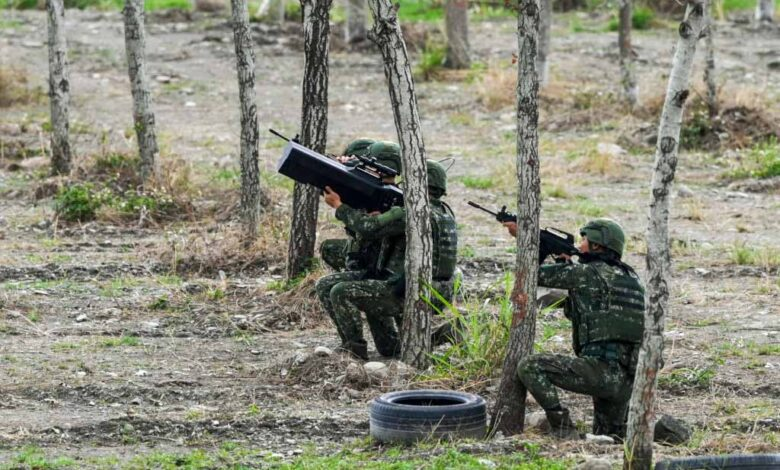
The surging use of drones by state and nonstate actors in the Indo-Pacific is turning uncrewed aerial vehicles (UAV) into key instruments of hybrid warfare. Affordable, scalable and increasingly autonomous, the systems enable surveillance, smuggling and sabotage across borders and along coastlines. In response, nations are developing counter-drone capabilities and expanding multinational defense cooperation.
“The rapid proliferation of drones in the Indo-Pacific region has changed the nature of hybrid threats,” Dr. Oleksandra Molloy, a senior lecturer in aviation safety at the University of New South Wales Canberra in Australia, told FORUM. “Small, cheap and widely available drones have collapsed the cost barrier to airpower. This low barrier to entry means that even smaller nations or nonstate actors can now field technologies that were once the domain of advanced militaries.”
With UAVs commercially available and easily modified, malicious actors can conduct surveillance or small-scale attacks while denying culpability, Molloy said.
Electronic warfare typically is the first line of defense against such threats, according to David Hambling, author of “Swarm Troopers: How Small Drones Will Conquer the World.”
“Against consumer drones used by careless or nefarious actors it is generally highly effective, as these drones operate on known frequencies which can be easily identified and jammed,” he told FORUM.
However, the challenge escalates with autonomous or military-grade drones, which may operate without active communications or rely on encrypted communication links, making them resistant to traditional jamming. To counter the threat, countries are adopting layered systems that integrate sensors, artificial intelligence (AI) and kinetic interceptors.
South Korea has accelerated deployment of radar-jamming systems against North Korea’s drone incursions, while Japan has tested laser-based interceptors developed domestically. Taiwan is boosting its capacity with locally produced jammers and interceptor drones, and Australia’s Project Land 156 seeks to deploy integrated counter-UAV systems.
“The question is no longer just which counter-drone system Indo-Pacific countries should acquire, but how quickly they can establish the commercial and military partnerships to keep up with the changing threat,” Molloy said.
Cooperation is a critical enabler. Multinational exercises now include live counter-drone drills and sensor-fusion testing, while technology-sharing agreements through frameworks such as the Quadrilateral partnership among Australia, India, Japan and the United States allow the exchange of detection algorithms and early-warning systems.
Swarming drones pose a serious threat. Designed to overwhelm defenses through volume and coordination, swarms demand rapid detection and response — often beyond human capability. “AI is increasingly being used to help spot, identify and track targets,” Hambling said. “This may become important when dealing with swarms … so that systems will be able to assign interceptors and will not be overwhelmed.”
AI-enhanced command and control fuses radar, optical and acoustic data into a single threat picture, enabling quicker decisions under pressure.
Regional resilience against drone threats also requires legal frameworks and clearly defined rules of engagement to prevent rogue incidents from sparking wider conflicts, analysts say. “To create a resilient and robust drone defense, Indo-Pacific countries need a layered system consisting of multimode sensors, layered active defenses and protective measures or passive defenses,” Molloy said.
About the Author