
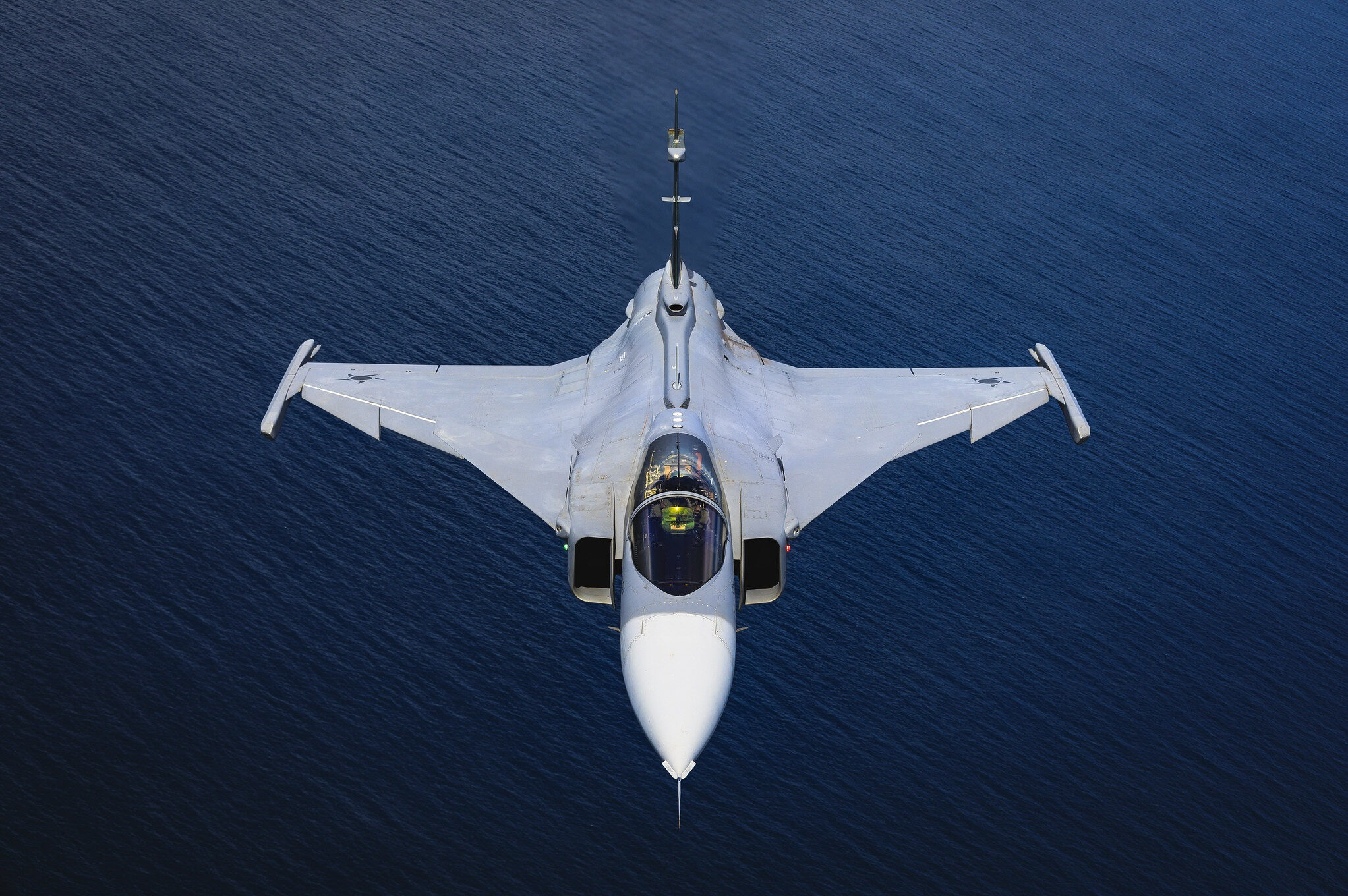
Canada may well cancel part of its 2022 order for 88 Lockheed Martin F-35As and replace them with Saab JAS 39E Gripens. One report suggests that Ottawa might cut the order in half and accept a Swedish offer for 72 lower-cost Saab Gripens.
The Gripen has matured and the F-35 is not as good a deal as it looked in 2021, but the driving factor is Washington’s trade and foreign policy.
Slashing the F-35 buy would be the first seismic fracture in a 70-year trade between the United States and those allies, including Australia and Japan, who did not maintain the ability to produce top-line combat aircraft and instead bought from the US. It foreshadows what I predicted soon after President Donald Trump’s re-election: a changed industrial and defence order based on collaboration among the US’s erstwhile buyers.
Low-friction interoperability in US-centred coalition forces was a strategic argument for the F-35, and the justification for the US exporting stealth technology. Another selling point for the F-35 was the power of mass: high production rates and a large fleet, along with a global logistics system, were intended to keep the cost of a large, complex aircraft within national budgets.
At the start of the F-35 program in 2001, Canada bought into both arguments. Today, it’s a raging debate that reflects internal and international politics, the performance of the program, and a Swedish industry seeking opportunities as US influence wavers.
Controversy dates back 15 years. Canada signed on to the production phase of the program in 2007, and the Conservative government of Stephen Harper (2006 to 2015) wanted to buy the F-35 without a competition.
Canadian law forbids this unless the government can show that only one contractor can do the job. The Harper administration’s ham-fisted efforts to do this were derailed by parliamentary budgeteers and the country’s auditor-general. The delay tipped the decision to Justin Trudeau’s Liberal government of 2015 to 2025, which reopened the competition.
Dassault and Eurofighter decided not to play. Boeing’s F/A-18E/F Super Hornet bid took a hit before the first bell: the company’s complaints about subsidies for C-Series airliner of Canadian company Bombardier prompted the Trump administration to impose retaliatory tariffs, forcing that project’s sale to Airbus. Canada finally chose the F-35 in March 2022 over the Gripen and Super Hornet.
That would have been the end of it, but Trump was re-elected, threatening tariff wars and calling for Canada to become the 51st state. This helped keep the Liberal party in power under new prime minister Mark Carney, with a promise to review the fighter program.
In relation to Canada, the Trump administration has been assiduously digging a deeper hole. The National Security Strategy released in December asserted US dominance over the Americas. Ambassador to Canada Pete Hoekstra warned on 26 January that the North American Air Defense (NORAD) agreement would be changed if Canada bought Gripens and that the US would have to send aircraft into Canadian airspace to cover the gap. Hoekstra, veteran Canadian defence journalist David Pugliese wrote, had ‘given Carney all the cover he needed’ to break from the F-35.
Right-wing separatists in the resource-rich Alberta province claim to have met with ‘senior’ White House officials. At the end of January, the US president made a bizarre threat to ‘decertify’ Canadian aircraft on the US register or impose further massive tariffs.
A seemingly damning excerpt from the 2021 evaluation was leaked to Canadian public radio in late November but had little effect except to underscore the change in the competitive balance.
Saab’s Gripen E and GlobalEye airborne warning and control aircraft, unproven in 2021, have entered service. Sweden has joined NATO, and Saab is talking to Bombardier, offering Canadia a manufacturing partnership and a system comprising Gripens and GlobalEye. A November visit to Canada by Sweden’s king and queen was a choreographed sales event.
When Canada made its 2022 decision, Lockheed Martin was promising a comprehensive Block 4 package of new sensors and computers for the F-35 by 2026 and improvements in availability and mission capable rates as the system matured. But since we reviewed the program here in August, reports from the Government Accountability Office in September, and from the Pentagon inspector general have been disappointing.
F-35s delivered since 2023 have software usable only for training. A plan for a new Block 4 package, cut back to fit schedules, budgets and the F-35’s thermal management capacity was due late last year, according to the accountability office, but has not yet been seen. RTX’s new Electro-Optical Distributed Aperture System (EO-DAS) for the F-35 has not finished tests. The inspector general’s report showed availability and mission capable rates well below threshold values and reported widespread cannibalisation.
Ottawa knows about this, I can confirm. Sixteen F-35s that Canada has paid for are secure; the rest, not so much.
One group solidly supports Canada staying with the F-35: retired senior leaders of the Royal Canadian Air Force. CBC radio reported in November that a dozen former commanders had signed a letter to Carney opposing any Gripen order.
CBC said one of the signatories of the letter was former defence staff chief Tom Lawson. He did not confirm signing the letter, but he commented, ‘The F-35 is so far beyond anything that the Gripen can provide that anything you’d be saving in terms of money by going to a second fleet would be lost, because that fleet would be close to useless in a wartime situation.’ Others taking the same view include former RCAF deputy commander Major General Colin Kiever, quoted as saying that cancellation would be ‘cutting our nose off to spite our face.’
First issue: culture eats strategy for breakfast, and change is fear. The RCAF has been joined at the hip to the US Air Force for more than 60 years. The two services’ leaders have trained and fought alongside one another, and the RCAF has not bought a non-USAF fighter since the mid-1950s.
Second: many of these leaders were personally involved in the acquisition of the F-35, and that was not always an ideal process. For example: The mandatory requirements that buttressed Harper’s sole-source procurement plan included an infra-red all-round vision system—uniquely met by the F-35’s EO-DAS, which hasn’t worked that well—but excluded transonic acceleration, an odd omission considering the NORAD role.
Third: it’s almost inevitable, given Canada’s position as a market for US defence equipment, and as a trade partner with the US for agriculture, energy and automotives, that US-funded lobbying is a major industry, along with US-owned media.
Acquisition, like war, may be too serious a matter to be left to the generals.
About the Author