
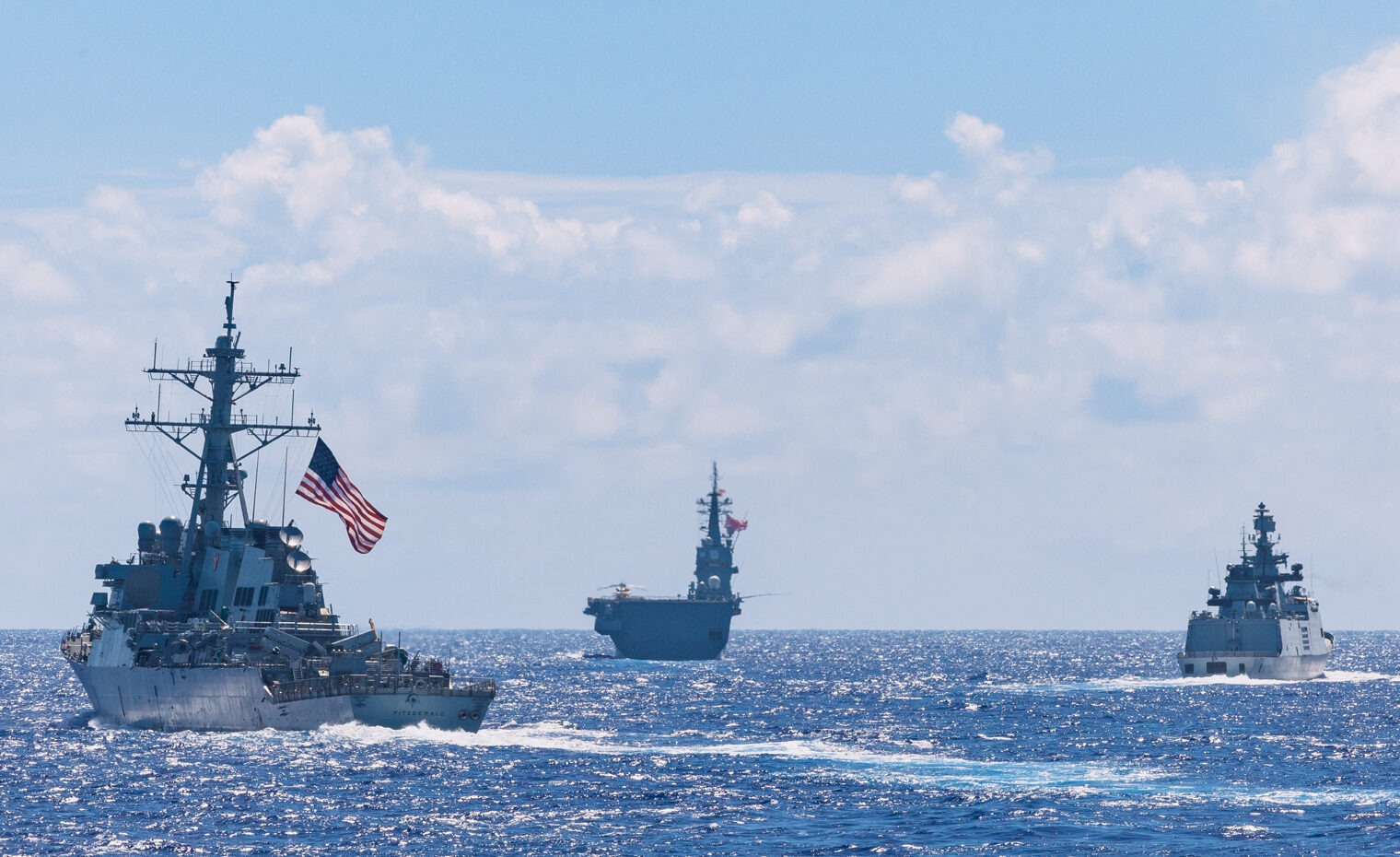
The Trump administration’s new defence and security policies affect the Indo-Pacific less through fresh promises than through fresh requirements for allies—and for Australia, that shift is immediate and concrete. The message is not ‘trust us’ but ‘build with us.’
US partners must aim for military resilience, strive harder to work with each other, and expect to handle second-order crises without much—or maybe even any—help from Washington.
The 2025 National Security Strategy (NSS, issued in December) and the 2026 National Defense Strategy (NDS, issued in January) point to a more constrained form of US reassurance. Washington will concentrate its most capable forces on deterring China, emphasising deterrence-by-denial along the first island chain, while accepting deeper trade-offs in other theatres. This is prioritisation under constraint: offering less global insurance and more focus on the pacing challenge.
Deterrence by denial—above all, dissuading China from trying to seize Taiwan—means that the United States and its partners must ensure the adversary can achieve no rapid success and present the world with a fait accompli. They must present the potential aggressor with the prospect that its opening move will be messy, slow and uncertain.
Capable partners are expected to assume greater responsibility in this and, as part of it, regional resilience. The NDS is blunt that US power will not compensate indefinitely for allies’ shortfalls, particularly in munitions, sustainment, industrial capacity and readiness. Reassurance is becoming conditional on what allies do in peacetime: stockpiling, hardening, dispersing, training and integrating.
For Australia, this reinforces the strategic rationale behind AUKUS, northern force posture and the need to strengthen its long-range strike capability. But it also demands greater self-reliance in munitions and sustainment—and the ability to fight through disruption. This means continuing to operate when airfields are cratered, ports are targeted, networks are degraded by cyber and electronic warfare, and supply chains are contested.
Allies should therefore read the strategies primarily as guidance for what to build, where to position forces and how to fight—not simply as statements of intent. The implicit test is no longer ‘Will the US show up?’ but ‘Can the combined force absorb the opening shock and still function long enough to make denial real?’
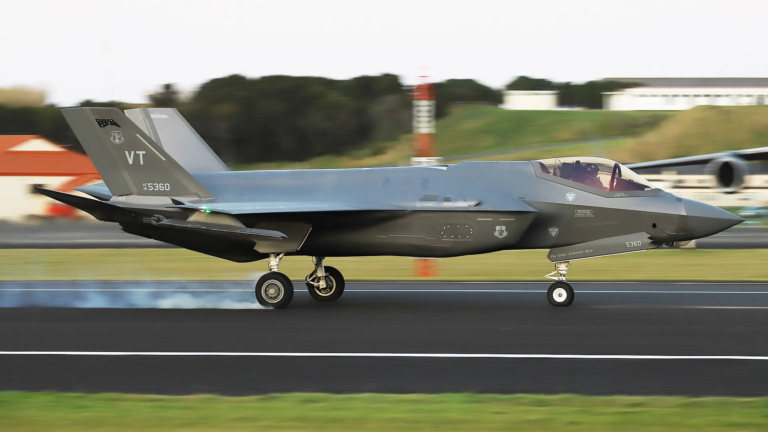
The first implication is posture and resilience. Passing Washington’s emerging credibility test requires dispersal, hardened infrastructure, redundancy in logistics, robust munitions stockpiles, and realistic plans for sustainment under pressure. Runway repair capacity must be in place, ammunition dispersed, spares on hand, communications protected, and air and missile defence sized for sustained operations rather than symbolic coverage. Without resilience, high-profile pieces of equipment—such as aircraft and ships—risk becoming brittle symbols rather than usable power.
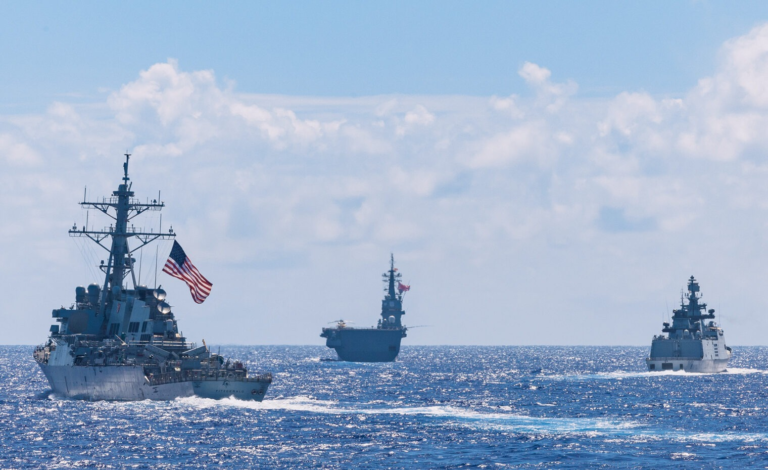
The second implication is that partner-to-partner defence cooperation is now foundational to denial strategies against China: the US’s friends must look to each other, not just to the US. Combined intelligence must feed targeting; targeting must connect to shooters across services and countries; undersea warfare must be coordinated; and integrated air and missile defence must function across borders under jamming, spoofing and cyber pressure. This comes from building connective tissue: shared data standards, secure pathways, common procedures and repetitive training that makes multinational kill chains routine.
Australia can act as an enabling hub in this network. Geography and access matter. But there are also Japan’s dispersal and standoff capabilities, the Philippines’ evolving access arrangements, and South Korea’s expanding responsibilities on its peninsula. These all become strategically more meaningful if they feed a shared operational design rather than parallel bilateral tracks. The alliance network better deters if it behaves like a network.
The third implication follows from tightening US prioritisation, and that is where the politics becomes uncomfortable. As Washington concentrates its most capable forces on deterring China while elevating homeland defence and managing commitments elsewhere, allies face harder political and capability choices. They must be able to manage secondary contingencies with little or no US support. The US is designing around scarcity and simultaneity. If it is optimising to be best in the primary theatre—the western Pacific—it cannot promise instant surge capacity for every crisis elsewhere. This is triage as strategy.
The US’s Indo-Pacific friends should reweight defence efforts towards readiness and away from replacing and modernising major equipment. Allies should invest less in boutique capabilities and more in endurance: stockpiles sized for weeks rather than days, infrastructure designed for repair rather than perfection, and command systems that function in degraded environments. Political readiness matters as much as military readiness—rapid consultation mechanisms, clear authorities, and pre-agreed assumptions about who does what when US attention is divided.
The strategic message of Washington’s new NSS and NDS is therefore double-edged. They sharpen focus on deterrence in the Indo-Pacific, but they also institutionalise a more conditional alliance bargain. Reassurance is increasingly measured not by what the US declares but by what the combined force can execute and endure. For allies, the central question is no longer whether US strategy sounds reassuring but whether their own posture, resilience and integration make deterrence-by-denial executable when it matters most.
About the Author