
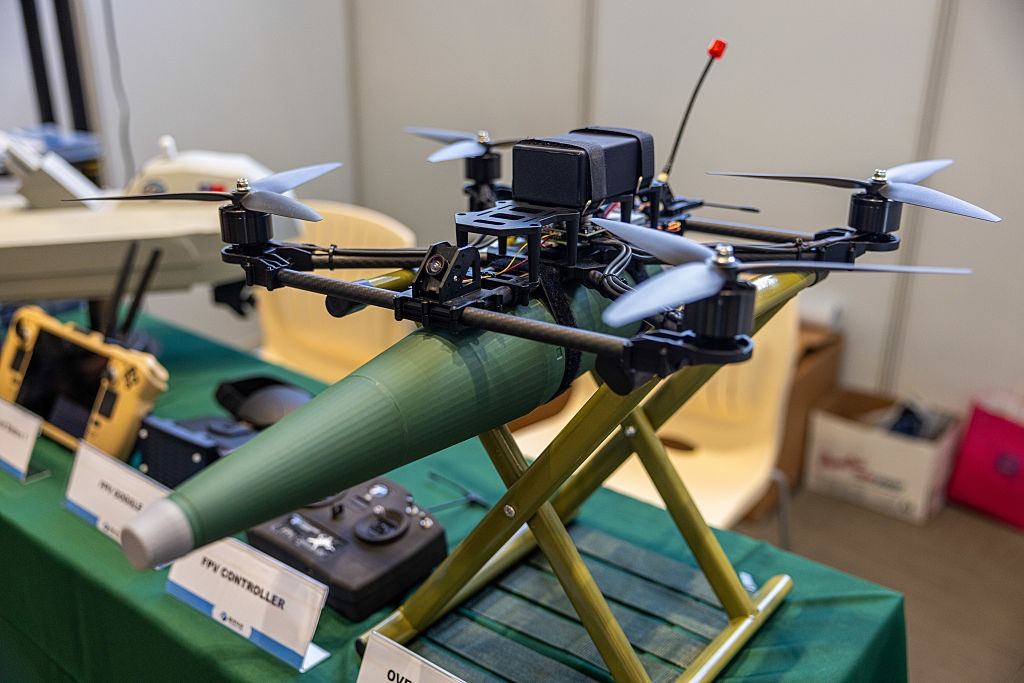
While Taiwan’s drone manufacturing program looks ambitious, it is nowhere near ambitious enough, as combat experience in Ukraine is making clear.
With the US-identified window when China will be capable of invading Taiwan just a year away, Taipei is not making drones fast enough nor planning to do so. Its drone makers also lack extensive access to battle experience.
Another problem is that Taiwan is running low on political unity, an intangible but powerful resource that could give the drone program the boost it needs.
Under its latest plan, Taiwan aims to spend around US$1.43 billion to procure 100,000 drones by 2028, including 48,750 locally manufactured military-grade drones, according to Taiwan’s government-backed Research Institute for Democracy, Society and Emerging Technology (DSET).
While this may sound like a lot, it contrasts with Ukraine’s production of 2 million drones in 2024 and goal to make 4.5 million drones in 2025. Kyiv made enough to train with, burn through and stockpile.
Taiwan’s goals are very modest by comparison, especially considering what it’s up against. In the opening stages of a conflict with China, Taiwan would likely burn through thousands of drones daily, if not hourly, according to a report from the US Naval Institute. One hundred thousand drones would quickly disappear.
Some of these shortcomings reflect the natural growing pains of starting a drone program from scratch. Until the Russian invasion of Ukraine in 2022, entering the drone market made little sense for Taiwanese manufacturers due to China’s longstanding dominance in the industry.
Commercial drone companies such as Shenzhen-based DJI have enjoyed a global market share of more than 70 percent, while China itself has become a major player in the global arms industry with its Wing Loong and Rainbow series drones.
Taiwan’s new program aims in part to help the private sector develop dual-use drones with both commercial and military applications. It also offers private companies the chance to win government contracts and subsidies, while also finding a new export market overseas in a growing industry.
It has seen some early successes. In September, the US Department of Defense approved its very first Taiwan-made drone for its Blue Uncrewed Aircraft Systems Cleared List, which identifies those that meet Pentagon standards for US military use. The approved drone was Thunder Tiger’s Overkill, a little first-person view aircraft that can travel at up to 120 km per hour for 30 minutes and carry a 3 kg payload.
Thunder Tiger is a model of how Taiwan wants its drone manufacturing program to run. Founded in 1979, the company products, ranging from toy aeroplanes to dental instruments. It was one of the first companies to sign on to the drone program and has been highly visible ever since. It’s attended military expos in the US, partnered with international companies such as the drone software company Auterion, and now made it onto the Pentagon Blue List.
Taiwan will also be building drones and drone parts for friends, as many Western governments are trying to build their own China-free supply chains due to security concerns.
Some of these goals are easier stated than achieved. Ukraine, for one, still depends on Chinese components, such as rare-earth magnets and lithium batteries. This dependence continues even as President Volodymyr Zelenskyy has separately accused Beijing of propping up Russia’s war machine.
Taiwan faces similar problems, according to DSET. Its drone companies also have far less access to users’ battlefield experience than foreign competitors due to the relatively small size of its industry and complexities around Taiwan’s diplomatic status. Russia, which has a ‘no-limits’ strategic partnership with China, is presumably telling Beijing what it’s learning on the battlefield.
Sunny Cheung, a global fellow at the institute, said:
Taiwan still lacks not only some key parts and large-scale production capacity (flight control-chips, thermal sensors, high-end GPS, and power systems) but also battlefield experience and operational data that come from using systems under combat conditions—something adversaries and competitors have gained from exporting and fielding UAVs abroad.
Taiwan has not fought in a war since the 1958 Second Strait Crisis against Beijing, and its military does not participate in United Nations peacekeeping missions. It’s also not supplying its allies with a steady stream of weapons to be tested in real-world settings, such as last year’s conflicts between Pakistan and India or Cambodia and Thailand.
This limits Taiwanese drone companies’ ability to innovate and adapt to rapidly changing conditions.
Removing China completely from the supply chain will take time. Finding alternative suppliers for critical parts is expensive for both Taiwanese government contractors and the private sector. In a conflict or a blockade Taiwan could face complete isolation for months at a time.
Washington gave Taipei a boost in December, approving its largest-ever weapons package for Taiwan, including Altius loitering munition drones and associated weapons parts.
More help may come from the 2026 US National Defense Authorization Act, which sets up a joint program for the US and Taiwan to cooperate on drone development, or the ‘fielding of uncrewed systems and counter-uncrewed systems capabilities for the Armed Forces of the United States and the military forces of Taiwan.’
The program could help address one of Taiwan’s greatest shortcomings in its drone program: access to the critical battlefield intelligence and experience that underlies drone design and development. It’s something China has in spades thanks to its close ties to Russia and its advanced arms industry.
This assistance may only go so far in Taiwan’s divided house.
Seeking to bolster Taiwan’s defences, President Lai Ching-te in November 2025 announced a special defence budget of US$40 billion to build a ‘multilayered “T-Dome” air defense network.’
The budget would allocate more funds for Taiwan’s drone program, but it’s been struck down several times by the main opposition party, Kuomintang, and its ally, the Taiwan People’s Party. Both parties are unlikely to change their position even after seeing China rehearse a blockade of Taiwan on December 29 and 30.
These are symptoms of a much greater problem in Taiwan’s government: the Democratic Progressive Party, which advocates for a unique Taiwanese identity, rules the executive with Lai at its helm, while the more China-friendly KMT and TPP rule the legislature.
The parties spent much of the past year fighting each other in the legislature, and 2026 is off to an equally grim start. This means that, for now, both political and logistical hurdles will continue to stand in the way of Taiwan building drone defences comparable to Ukraine’s.
About the Author