
While Australia’s defence strategy has moved north at speed, its permanent workforce has not.
The latest analysis product from ASPI’s Northern Australia Policy Centre maps the distribution of regular Australian Defence Force members across Australia between 2015 and 2025. It shows that while total ADF personnel (permanent and reserves) grew nationally by 11,617 people or 13 percent, the Northern Territory moved in the opposite direction, with its permanent presence declining by around 12 percent over the same period. Strategy has shifted forward; the workforce map has not. (Figures in this article come from Department of Defence annual reports.)
Over the past decade, growth has been visible in Canberra as a command centre, in Western Australia as a maritime and industrial hub, in Queensland as a sustainment and training corridor and in Victoria as a logistics and advanced systems base. But in the Northern Territory, Australia’s forward operating edge, permanent numbers have contracted.
In Darwin alone, permanent army postings fell from 3,124 in 2015 to around 2,557 in 2025. That decline is closely linked to structural changes, including relocation of the 1st Armoured Regiment to South Australia in 2017, and compounded by pressures related to Covid-19 and broader workforce constraints. Today, the territory’s Defence workforce remains heavily army-weighted, with approximately 2,557 permanent army personnel and 743 reservists. The navy (around 604 permanent members) and the air force (around 1,018 permanent members) maintain smaller presences with limited reserve depth.
This divergence matters because strategy has fundamentally changed. Between 2015 and 2025, Australian defence policy shifted from long-horizon expansion to force optimisation, prioritising readiness, resilience, deterrence and integrated capability. Russia’s invasion of Ukraine reintroduced high-intensity, attritional warfare as a live planning scenario. Instability in the Middle East underscored maritime and energy vulnerabilities. Intensifying Indo-Pacific competition shortened warning times and increased the premium on forward posture, interoperability and sustained presence.
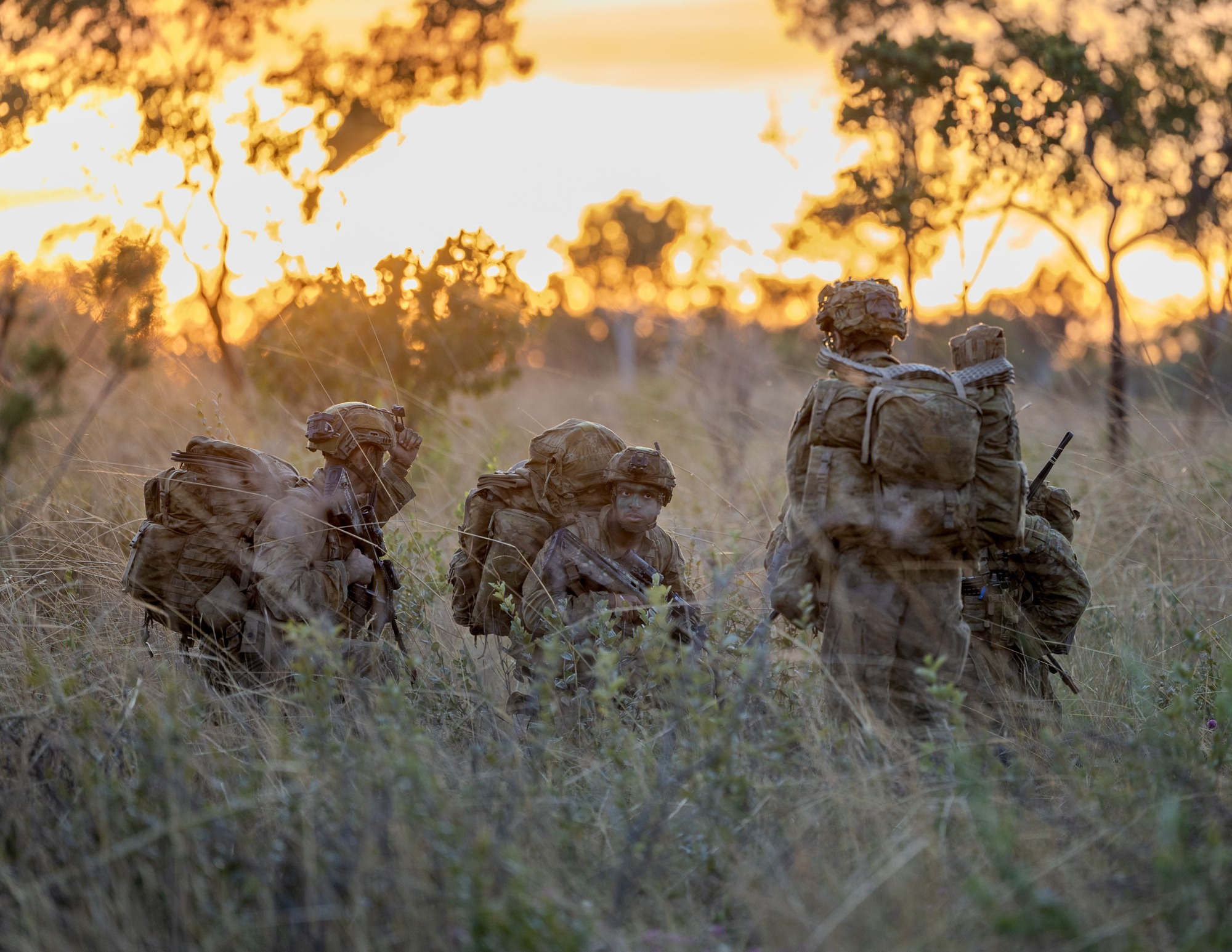
The north sits at the centre of this operating environment. The Northern Territory hosts Australia’s most forward land forces. It underwrites major multinational exercises, such as Pitch Black, Talisman Sabre, Kakadu and Predator’s Run. It routinely absorbs short-duration surges ranging from roughly 700 to more than 4,000 personnel per activity. It supports coalition engagement with more than 30 nations. The US Marine Rotational Force–Darwin adds around 2,500 US Marines on six-month rotations each year. But this is a surge layered onto a thinner permanent base.
In effect, Australia has increased the strategic weight carried by each Defence member in the Northern Territory without increasing the number of members. National Defence workforce growth has followed function rather than geography. That reflects rational decisions shaped by sunk capital costs, as bases, housing, logistics systems and industrial ecosystems can’t be relocated lightly. Efficiency has encouraged concentration of complex systems, headquarters functions and advanced industrial capability in established southern and western hubs.
But in an era of compressed warning times and distributed operations, efficiency must be balanced with effectiveness. A force structured primarily around peacetime cost efficiency may struggle to scale under pressure if workforce mass and enabling functions aren’t embedded in the theatre most likely to generate sustained operations. Rotational presence demonstrates commitment, but it doesn’t substitute for structural depth.
A tendency for Defence people to quit after assignment to northern Australia is often cited as a constraint on expanding the permanent force there. But that only means Defence must do something to overcome the problem, not avoid it. Northern Australia’s climatic conditions are hardly unique. More than 680 million people live in Southeast Asia in comparable tropical environments.
Weather is not the binding constraint. Rather, the main problems are several that governments can control: housing availability, schooling, spousal employment pathways, posting cycles, incentives and career progression.
The need to build strength in the north goes beyond uniformed numbers. Australia is seeking a more distributed and scalable defence industrial base, including across northern Australia. A distributed defence industry demands a distributed skilled workforce, logistics specialists, engineers, technicians, planners and reservists close to bases from which operations would be launched.
Industry would have to scale up in a crisis, too. It can’t unless a sufficient uniformed workforce is already there to support the expansion.
The past decade has shown that Australia can grow its defence workforce. The data in this new analysis makes clear that growth has not been evenly aligned with strategic geography. If the Northern Territory is to remain Australia’s forward operating edge and carry increasing strategic weight, then workforce settings must evolve accordingly. Targeted, enduring growth in enabling functions in the north would strengthen readiness without requiring indiscriminate relocation elsewhere.
Strategic weight without workforce depth is a risk. With shortened warning times and rising operational demands, the location of people is as consequential as their numbers. The numbers over the past 10 years are clear. The question for policymakers is whether the next decade will finally align the workforce map with Australian strategy.
About the Author