
In a matter of weeks, the Trump administration has proclaimed a new national security strategy and declared war on the status quo in defence acquisition, via executive order. Defence contractors’ use of share buybacks and dividends to boost stock price will be regulated away. The use of artificial intelligence in the Pentagon’s administration will be not so much facilitated as mandated.
No defence executives, Donald Trump said on social media, should be paid more than US$5 million per year until their companies invest in production. He singled out RTX, owner of the Raytheon missile business and Pratt & Whitney engine business, as ‘the least responsive to the needs’ of the Pentagon. ‘Either Raytheon steps up and starts investing in more upfront Investment like Plants and Equipment, or they will no longer be doing business with Department of War.’
While the old defence industry is clearly out of favour, the new one, composed of newish companies such as Anduril and SpaceX, is just as clearly in the administration’s good books.
Defense Secretary Pete Hegseth, in the week of 12 January, engaged in a barnstorming ‘Arsenal of Freedom’ tour, with a stop in Texas at SpaceX, where he delivered an address replete with praise for the company’s mercurial founder. ‘Artificial intelligence, autonomous systems, quantum, hypersonics and long-range drones: if you talk to Elon Musk long enough, he will tell you how important they are, and he’s 100 per cent correct.’
‘Winning requires a new playbook. Elon wrote it with his algorithm: question every requirement, delete the dumb ones and accelerate like hell.’ Hegseth called for ‘an AI-first warfighting force across all domains.’
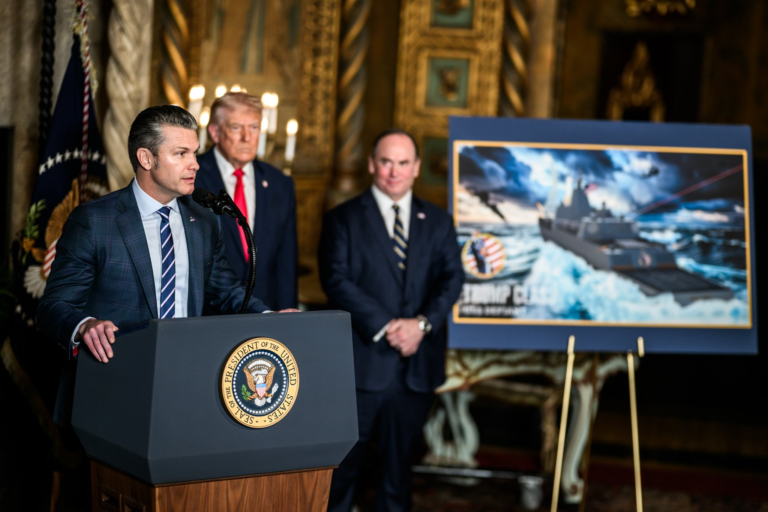
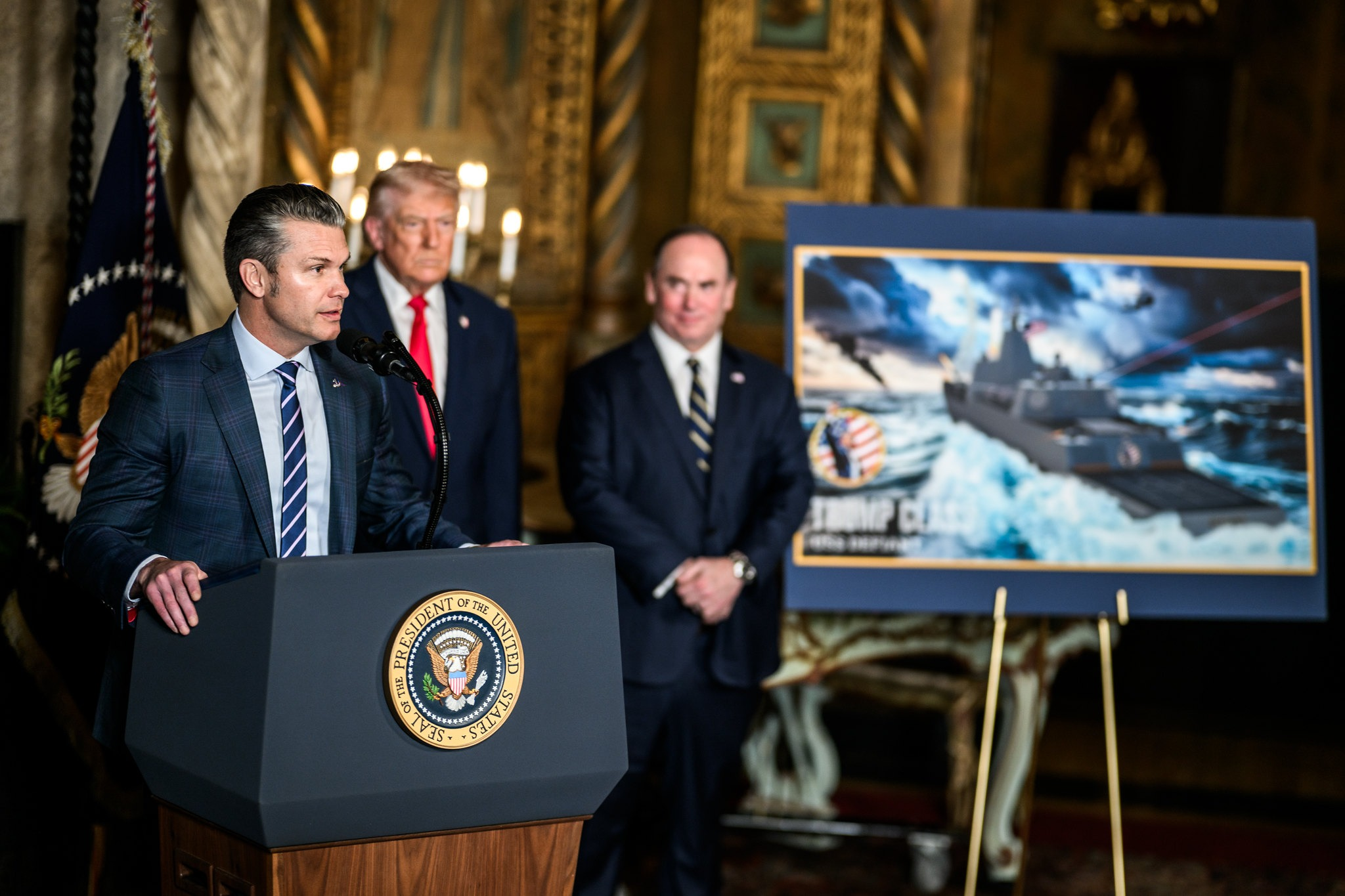
Also demanding industry investment was Navy Secretary John Phelan at the Surface Navy Association’s national symposium on 13 January. He told US shipbuilders that they needed to hire 250,000 workers over the next 10 years to fulfil Trump’s Golden Fleet plan, including a new class of ultra-large surface combatant.
This is music to the ears of Musk and his colleagues in the First Breakfast movement, named in reference to the 1993 Last Supper meeting that kicked off the post-Cold War consolidation of the US defence industry. It’s what they planned, as I wrote in December 2024. But Hegseth and his team will face opposition and problems.
Trump might be mad at RTX but cutting off its government business would halt deliveries of the F-35 and most of the US Air Force’s and US Navy’s missiles. Trump is not Xi Jinping. It’s not clear how restrictions on buybacks, dividends or executive compensation would be enforced unless written into both federal rules and new contracts. Heavy-handed action could result in lawsuits that would make the 23-year case over the cancellation of the Navy’s A-12 bomber look like pleading out a traffic ticket.
The administration could selectively ban non-compliant companies from competing for some contracts. But the Last Supper booby-trapped this option: banning one qualified bidder often leaves the government negotiating a sole-source contract with the other one.
Perhaps prime contractors should not prefer buybacks to investment, but both established and start-up companies must recognise that this is defence. Build a dry dock to assemble a 270-metre warship on venture-capital funding? When the next administration cancels the battleship, who else will buy one from you?
So far, private industry has focused on smaller hardware items that can be developed quickly, on software and on multi-use products, such as Anduril’s solid rocket motors. The Tech Bros’ record with complex systems that live in the physical world is mixed. There is SpaceX, but it makes things that Wernher von Braun would have understood instantly, and there is the eVTOL craze, which after almost a decade and double-digit billions hasn’t shown the ability to perform a simple mission.
And one of Hegseth’s AI pledges in his SpaceX speech might raise some eyebrows. Data, he said, must be shared within the AI system: service secretaries now have 30 days to report all their current data, to train department-wide AI engines. Recalcitrance will be punished by defunding or termination: ‘Data hoarding is now a national security risk, and we will treat it that way.’
But Hegseth went on to announce that ‘appropriate data from across our intelligence enterprise will receive the same treatment.’ Let’s be clear: Hegseth wants to open up as much intelligence data as possible to a system known for gross errors and hallucinations.
But some observers wonder if fewer complex weapons are the plan, if not for Trump then at least for his would-be heirs. Veteran industry analyst Richard Aboulafia remarked on a 9 January Aviation Week podcast: JD ‘Vance and his associates, the Michael Antons and Bridge Colbys who formulated this strategy, [are] going to be in the ascendancy. They might just say, “No, we don’t need any of this because we’re surrendering to Russia and China. And the only thing that matters is having a couple of squadrons of planes to deal with the likes of, well, Venezuela”.’
There is going to be a conflict within the military-industrial complex, and it is hard to tell who will prevail. On the administration side, Hegseth is fond of on-camera physical exercise but left the army as a major and became a right-wing activist and TV host. Navy Secretary Phelan is a financier and donor. At the desk of the Secretary of the Air Force, Troy Meink has service experience, but in the narrow world of space operations. The same pattern occurs across the appointed leadership: finance, ideology, little military or industrial experience.
The opposition—the traditional defence industry—is dug in behind parapets of law, regulation and politics, not to mention the laws of economics and industrial reality. You might think the Pentagon would have learned a lesson, in Vietnam and Afghanistan, about an adversary that has been fighting an existential battle for decades on its own terrain.
About the Author