

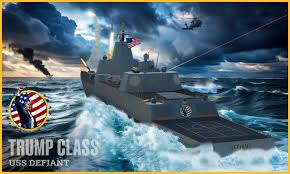
The U.S. Navy’s top officer wants directed energy weapons to become the go-to choice for the crews of American warships when faced with close-in threats. He also said that more powerful megawatt-class lasers should not be seen as “beyond” the capabilities that could be found on the future Trump class warships. The Navy has been a leader within the U.S. military in fielding laser weapons and is actively pursuing systems that employ high-power microwaves, but there continue to be significant hurdles to these efforts.
Chief of Naval Operations Adm. Daryl Caudle talked with TWZ and other outlets about his service’s directed energy weapon plans at a roundtable at the Surface Navy Association’s (SNA) annual symposium earlier today. Caudle has long been an outspoken proponent of directed energy capabilities.

“My thesis research at [the] Naval Post Graduate School was on directed energy and nuclear weapons,” Caudle said. “This is my goal, if it’s in line of sight of a ship, that the first solution that we’re using is directed energy.”
In particular, “point defense needs to shift to directed energy,” the admiral added. “It has an infinite magazine.”
When it comes to point defense for its ships, the Navy currently relies heavily on Mk 15 Phalanx Close-In Weapon Systems armed with six-barrel 20mm M61 Vulcan rotary cannons and launchers for RIM-116 Rolling Airframe Missiles (RAM). Each Phalanx has enough ammunition to fire for a total of around 30 seconds, at most at the lower of two rate-of-fire settings, before needing to be reloaded. RAM launchers available today can hold either 11 or 21 missiles at a time, and the latest versions of those missiles cost around $1 million each. Many ships across the Navy also have 5-inch or 57mm main guns, and/or 30mm automatic cannons, which can also be used against close-in threats.
Recent Navy experience during operations in and around the Red Sea has underscored the value of magazine depth and concerns about expenditure rates of traditional munitions.
“What that does for me is it improves my loadout optimization, so that my loadout, my payload volume is optimized for offensive weapons,” Caudle said of adding new directed energy weapons, and lasers in particular. Furthermore, “as you increase power, the actual ability to actually engage and keep power on target, and the effectiveness of a laser just goes up.”
To date, the plurality of the Navy’s available shipboard directed energy weapon capabilities are split between two systems: the Optical Dazzling Interdictor (ODIN) and the High-Energy Laser with Integrated Optical Dazzler and Surveillance (HELIOS). ODIN and HELIOS systems are currently installed on a number of Arleigh Burke class destroyers.
HELIOS is a 60-kilowatt class design, which is powerful enough to destroy or at least damage certain targets, such as drones or small boats. Its beam can also be used as a ‘dazzler’ to blind optical sensors and seekers. Those same optics could be damaged or destroyed in the process, as well. Manufacturer Lockheed Martin has talked in the past about the possibility of scaling HELIOS’ power up to 150 kilowatts.
The Navy has tested more experimental laser directed energy weapons on other warships in the past. The most recent known example of this was the integration of a 150-kilowatt design called the Laser Weapon System Demonstrator (LWSD) Mk 2 Mod 0 onto the San Antonio class amphibious warfare ship USS Portland in 2019. The LWSD Mk 2 Mod 0 has since been removed from that ship. The Navy just released a picture yesterday showing it at the Naval Surface Warfare Center, Port Hueneme Division’s (NSWC PHD) Directed Energy Systems Integration Laboratory (DESIL) at Naval Base Ventura County at Point Mugu in California.
Higher-powered laser directed energy weapons in the 300 to 600 kilowatt classes are also in the Navy’s publicly stated plans, with a focus on improving shipboard defense against incoming cruise missiles. The service has said that each one of the future Trump class large surface combatants could be armed with two 300-kilowatt lasers, as well as a pair of 600-kilowatt types, along with four ODINs. It’s also worth noting here that the Navy has not ruled out using nuclear propulsion on these ships, which could help meet power generation requirements. You can read more about what is known about the design of those ships.
About the Author