
US President Donald Trump recently threatened Canada via social media: “If Canada makes a deal with China, it will immediately be hit with a 100% Tariff against all Canadian goods and products coming into the U.S.A.”
The trigger was Canadian Prime Minister Mark Carney’s announcement of “a new type of strategic partnership” between China and Canada, featuring dramatic tariff reductions – China will lower tariffs on Canadian canola oil from 84 percent to 15 percent. In comparison, Canada will reduce tariffs on Chinese electric vehicles from a 100 percent quota-based rate to 6.1 percent.
Trump accused Canada of seeking to become a “Drop Off Port” for Chinese goods entering America and canceled Canada’s invitation to join his so-called Board of Peace.
It may appear to be yet another US tariff tantrum. But in reality, it signals a broader geopolitical shift, highlighting a critical fracture in the postwar international order and suggesting that alliances are becoming more fluid and less predictable.
Canada is not the Philippines. It is not a minor nation testing the boundaries of American influence. Canada is among Washington’s closest allies, sharing the world’s longest undefended border with the US. Over 70 percent of Canadian exports flow to American markets.
The North America Free Trade Agreement, and now the US-Mexico-Canada Agreement (USMCA), have bound the two economies so deeply that conventional wisdom long held that Canada would be the last country to openly defy US strategy toward China.
Yet Canada has done exactly that. This single act shattered a crucial psychological barrier: Allies are no longer bound by an ironclad rule to choose sides between Washington and Beijing. Allies are partners, not vassals to be commanded and exploited at will.
This episode demonstrates Canada’s capacity for independent decision-making and reinforces confidence in its sovereignty.
For years, Washington has constructed a global strategy based on bloc politics – either you’re with us or with China, with no middle ground permitted. To enforce this binary logic, the US has weaponized trade policy by imposing tariffs on China, restricting technology exports, and demanding that allies follow suit.
The USMCA even contains a “poison pill” clause, effectively granting Washington veto power over any member’s free trade agreements with “non-market economies” – a thinly veiled reference to China.
The underlying assumption of this strategy is simple: Allies have no choice but to comply with American demands, even at the expense of their own interests. Canada’s actions demonstrate otherwise; there are choices.
This fracture is not accidental. It reflects the inevitable surfacing of structural contradictions.
Washington demands comprehensive allied alignment on security, economic, and technological fronts, yet has been unable to provide adequate economic incentives or a system that safeguards partners’ interests. Unquestioning obedience to the US – a potentially volatile and unpredictable partner – is inherently risky. Canada’s trade diversification strategy exemplifies sound risk management.
Washington’s response only accelerates the fracture’s expansion. The US playbook consists of threats, humiliation, and pressure. This generates a counterforce: The more allies feel coerced, the more urgently they seek hedging strategies.
More fundamentally, global economic realities demand cross-bloc cooperation. Supply chains for critical minerals, clean energy, semiconductors, and biopharmaceuticals are inherently global and cross-regional.
Excising China from these chains may be technically feasible but economically prohibitive. For allies, complete decoupling means lost markets, higher costs, and missed industrial opportunities.
For Canada, real growth lies in Asia, where Chinese demand for agricultural products, energy, and clean technology represents an engine of future expansion. The USMCA provides a safety net but cannot fulfill Canada’s growth ambitions.
Even politically aligned allies loyal to Washington will repeatedly “cheat around the edges” in practice. Each deviation widens the fracture.
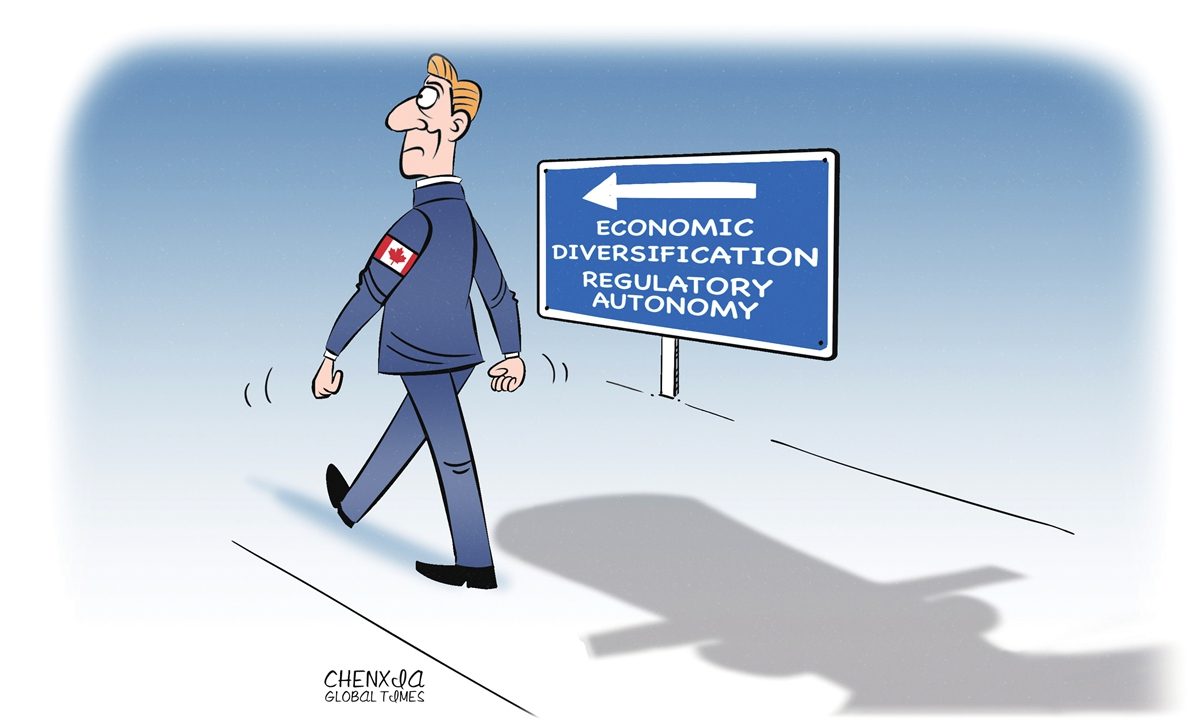
The consequence of this expanding fracture is clear: An increasing number of middle powers are adopting a dual strategy: “security with America, economic diversification, and regulatory autonomy.”
Middle powers are learning a lesson Washington seems determined to teach: diversification is not betrayal – it is survival.
The world will not reorganize into neat “West VS East” camps. Instead, we will see fluid, overlapping, partial alliances and transactional networks. Geopolitical certainty declines, but national autonomy rises.
Canada’s deal with China is not an isolated incident. It is a signal that the American-led order based on geographic and ideological division is disintegrating from within.
The fracture has appeared and will continue expanding. Efforts to seal it through threats and coercion will only accelerate its growth.
About the Author