
Despite the United States pushing to acquire Greenland, geological and technical constraints have so far prevented any country – including China – from successfully extracting and processing one of the Danish territory’s main critical minerals, a New York-based mining investor said.
“In the Arctic, one of the popular – the sort of commonly occurring mineral – is called eudialyte,” said Tomasz Nadrowski, portfolio manager at Amvest Terraden, an investment and corporate finance firm specialising in natural resources.
“So far, no one has managed to successfully extract and separate rare earth oxides from eudialyte: not the Germans, not the Finns, not the Chinese, not the Russians.”
“Maybe science will find a solution one day, but not today.”
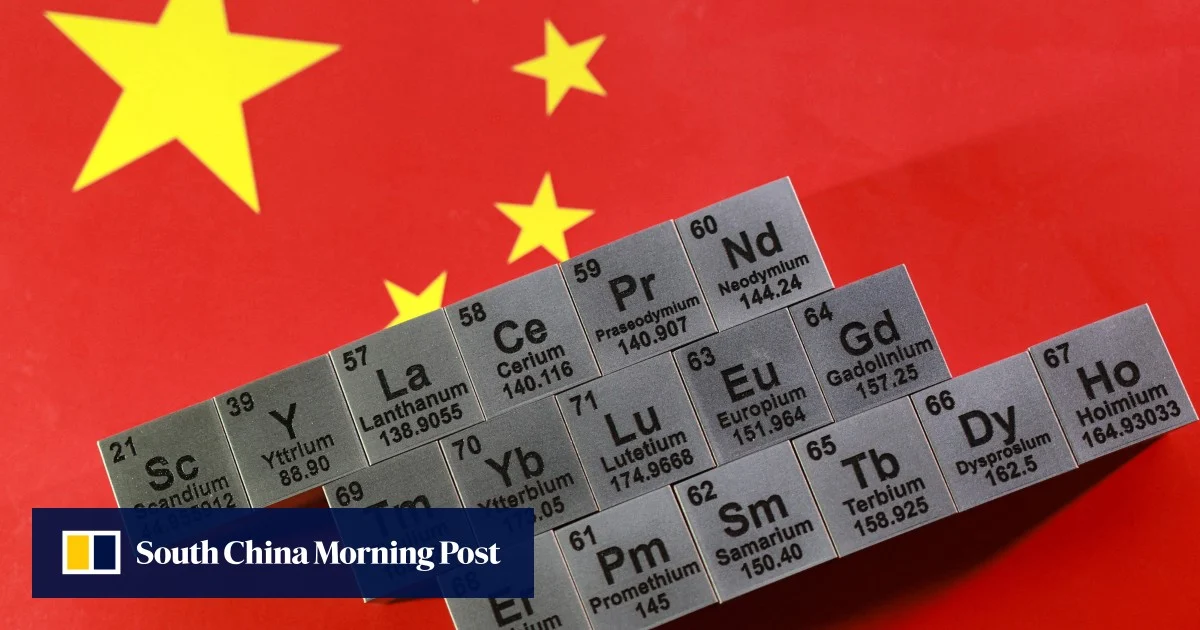
The stakes are high. If processed at a commercial scale, eudialyte’s rare earth elements could be used to make permanent magnets – essential components in numerous hi-tech products.
At present, China has a functional monopoly on the trade of these materials thanks to its unmatched refining capacity, with the country controlling about 90 per cent of the global supply.
That dominance has intensified pressure on the US to diversify supply chains, particularly after Beijing imposed export controls on critical minerals following the trade war Washington launched last April.
China had been “very strategic” in its approach to the sector, Nadrowski said, whereas Western countries had treated critical minerals as a “peripheral part” of capital markets – forcing them to now play catch-up.
To counter Beijing’s leverage, Washington has adopted a dual strategy: forging international partnerships and developing domestic capacity. US President Donald Trump has signed critical mineral agreements over the past year with Australia, Saudi Arabia, Malaysia, Thailand, Japan, the Democratic Republic of Congo and Ukraine.
“I think those bilateral relationships do matter because different countries have different strengths,” said Nadrowski, also the author of Mineral War, citing Japan and South Korea’s “very good” metal refining industries.
The Trump administration is also working to build up its domestic industry. On Monday, Reuters reported that the US government would take a 10 per cent stake in USA Rare Earth to help the company develop a home-grown mine and magnet facility.
In July, MP Materials announced a public-private partnership with the US Department of Defence to accelerate the creation of an end-to-end rare earth magnet supply chain and reduce reliance on foreign suppliers.
Nadrowski said it made sense for the US to rebuild a “healthier value chain” outside China. “It’s not healthy if you have one country producing everything and other countries producing nothing,” he stated.
But he cautioned that establishing a rare earths industry would be “a long journey”. A large mine in the West could take about 15 years to develop while some minerals in Greenland would take even longer to bring into production, he said.
If Trump’s plan spans 20 years into the future, “that’s fantastic”, he stated.
The Danish territory alone presented several obstacles, according to Nadrowski. “There used to be a mining industry in Greenland, historically on the fringes or near the coast. Otherwise, access is very difficult,” he said, pointing to a lack of infrastructure and harsh weather that limits the operating season to about three months a year.
“The West”, he added, “should be a little more humble”, given that even Chinese firms had failed to develop a commercially viable eudialyte industry in Greenland.
Nadrowski also highlighted other constraints. “The main reason why Westerners were not very keen on having the rare earth industry on their own soil is that it’s environmentally damaging,” he said. “Rare earth elements in the soil are associated with radioactive materials.”
About the Author