


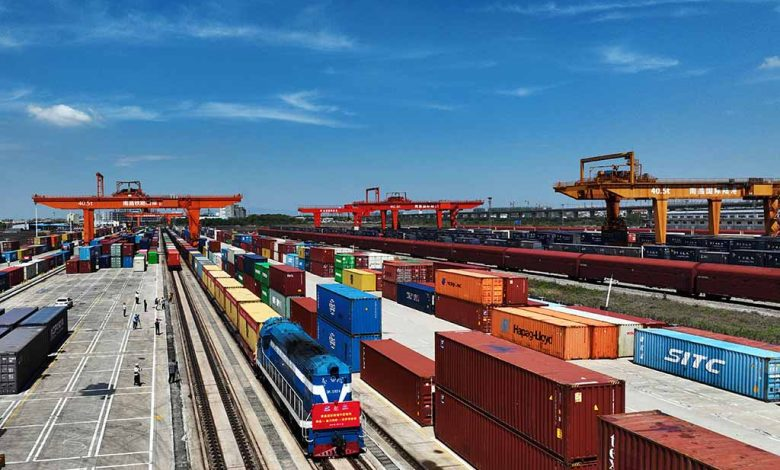
United States intelligence officials say Beijing has been helping Iran circumvent United Nations sanctions, with Tehran reportedly using a 10,000-kilometer rail corridor with China to bypass the U.S. naval blockade that is choking the Iranian regime’s oil exports.
Land routes, using rail and truck traffic, could act as a backdoor path to resupply Iran with Chinese-made components for drones and missiles, and precursors for rocket fuel and other materials, analysts say. China supplied those items to Iran via ship during the early weeks of Tehran’s conflict with Israel and the U.S.
However, those land routes are unlikely to provide much relief to Iran’s oil industry because of the reduced cargo volume, experts say. By violating the sanctions to supply Iran with military resources, potentially including weapons and intelligence, China would extend the conflict and further limit energy supplies. That would lengthen how long countries, especially in the Indo-Pacific, must endure increased gasoline and oil prices.
International sanctions tied to Iran’s pursuit of nuclear weapons have blocked direct sales of Iranian oil since 2018. Yet Iran continued to sell oil to China by using a shadow fleet of tankers that disguise their cargo’s origin. The U.S. blockade has crippled that illicit trade.
Before the conflict started in late February 2026, China was Iran’s largest trading partner, buying about 90% of oil exported by Iran and “providing tens of billions of dollars in annual revenue that supports Iran’s government budget and military activities,” according to the U.S.-China Economic and Security Review Commission.
China sent five shipments of sodium perchlorate, a rocket propellent ingredient, to Iran before the U.S. established its naval blockade in mid-April, the Institute for the Study of War, a Washington, D.C.-based think tank, reported.
China’s provision of such precursors would indicate “they are actively supporting Iran producing more ballistic missiles and producing them in real time — as in soon enough to try and turn them on the U.S. allies in the region,” an intelligence source told 19FortyFive, a U.S.-based defense and security news website. Only nations with significant chemical industries can provide such chemicals at the scale required for missile programs. The Islamic Republic of Iran Shipping Lines Group owns all of the supply vessels involved.
The U.N. reimposed sanctions related to Iran’s nuclear program in September 2025 based on Tehran’s continuing noncompliance with its nuclear commitments. U.N. Security Council resolutions now in force include bans on the sale of such dual-use chemicals to Iran; the export of conventional arms to Iran; providing financing, training or other resources relevant to advancing the regime’s nuclear program; as well as nuclear enrichment and other activities. The European Union, the United Kingdom and the U.S. also reimposed related sanctions.
China may also be violating those U.N. resolutions. In April 2026, U.S. intelligence officials said Beijing may have sent Iran shoulder-fired, anti-air missiles potentially for use in the conflict, The New York Times newspaper reported.
“Chinese companies have continued to sell the Iranians sanctioned dual-use technology that enables Tehran to keep building weapons and enhance its navigation systems, sources said, but the Chinese government directly transferring weapons systems would mark a new level of assistance,” CNN reported.
The New York Times reported in mid-May that “Chinese companies have been discussing arms sales with Iran, plotting to send the weapons through other countries to mask the origins of the military aid, according to U.S. officials.”
Such activities could be interpreted as further breaches of U.N. Security Council resolutions, analysts say.
China also may be providing intelligence to Iran. Chinese firms, some tied to the People’s Liberation Army, are marketing intelligence obtained through AI and open-source data that details U.S. force movement, The Washington Post newspaper reported in April 2026. Intelligence supplied by private firms such as MizarVision and Jing’an Technology also enables Beijing to aid Iran yet distance itself from the conflict.
“The state can benefit from private sector innovation and it can likewise disclaim, credit or blame for the actions of ostensibly private companies, even when they are operating at the direction of the state or with the strong alignment of the state,” Ryan Fedasiuk, a fellow at the American Enterprise Institute think tank, told The Washington Post.
Although land routes can supply the Iranian economy with food and manufactured goods, commodities traded in bulk, such as oil, rely on the efficiencies of sea transport. Shipping carries more than 80% of global trade by volume, according to the U.N.
Iranian and Chinese trains began moving cargo on the Kazakhstan-Uzbekistan-Turkmenistan-Iran corridor in 2016, mostly as an export corridor for Chinese goods. That rail traffic remains relatively modest.
Cargo trains traveling between Xi’an in central China and Tehran averaged about one per week before the start of the conflict, according to Bloomberg News. That increased to about one every three or four days after the U.S. naval blockade began.
Trains are faster than ships but sacrifice capacity. Crude oil tankers can haul up to 2.2 million barrels, according to Energy News Beat, which covers the oil and gas industry. By comparison, a train with more than 100 cars could haul only 70,000 barrels.
“Iran would need roughly 25-35 such trains. The entire corridor’s current daily throughput — dominated by general containers and non-bulk freight — is nowhere near that level,” the news agency reported.
The naval blockade means the outlook for Iran’s oil-based economy remains gloomy. The country usually produces about 4 million barrels of oil a day, about half of it exported. Most of that is held in onshore tanks, which soon will reach capacity if not relieved by the return of seaborne trade. A long-term collapse in oil revenue could follow.
“The sea blockade is a much more serious threat than even war, and the current stalemate must be broken because the export of our oil and energy and the fate of our refineries is now at risk,” Hamid Hosseini, an expert on Iran’s oil sector at Iran’s Chamber of Commerce, told The New York Times.