



Allied and partner nations across the Indo-Pacific are strengthening interoperability, enhancing deterrence and building enduring relationships capable of responding to an increasingly complex security environment, senior military leaders and defense experts said during the 2026 Land Forces Pacific (LANPAC) Symposium and Exposition in mid-May in Hawaii.
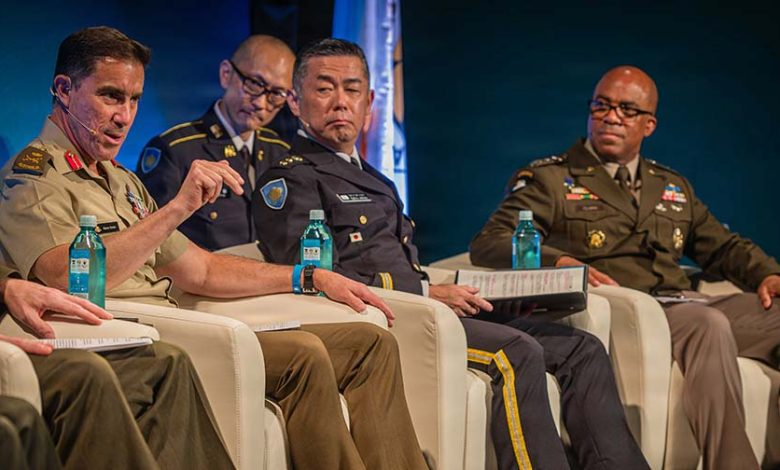
A panel discussion emphasized the importance of trust, persistent presence and multinational cooperation in maintaining a free, secure and prosperous region. Gen. Ronald Clark, commanding general of U.S. Army Pacific, moderated the panel that included Maj. Gen. Matthew Mowery, deputy commander of U.S. Marine Corps Forces, Pacific; Maj. Gen. Joseph Pasamonte, commander of the Philippine Army’s 7th Infantry (Kaugnay) Division; Gen. Masayoshi Arai, chief of staff of the Japan Ground Self-Defense Force; and Lt. Gen. Simon Stuart, chief of the Australian Army.
The leaders emphasized how combined training, operational cooperation and shared strategic interests have strengthened the land power network across the region and transformed collective will into collective capability.
Stuart said the Indo-Pacific security environment has created a unique opportunity for Allies and Partners to work together.
“We have almost a perfect storm to create unity of effort through unity and purpose, founded in our shared interest to prevent a hot war in our region,” he said. “We have made exceptional progress … and we’ve actually achieved a huge amount together.”
Arai highlighted Japan’s commitment to regional engagement and defense cooperation, noting that Japan must “continue to improve the qualities of the defense cooperation … and contribute to peace and stability.”
Panelists also discussed how emerging technologies, including artificial intelligence, cyber capabilities and uncrewed systems, are reshaping how militaries train and operate together. Pasamonte stressed that while modernization remains critical, military leaders must continue to learn from past conflicts.
“While we’re trying to innovate moving forward … we must try to look back,” he said. “We also look at our past and try to harness all those lessons that we learned.”
Mowery said trust and interoperability remain essential as allies continue to integrate new technologies and operate together across the region.
“The Marine Corps is committed to being the first island chain force, and how we do that is through our partnerships,” Mowery said, referring to the string of archipelagoes that stretches from Japan to Indonesia. “It’s through consistent relationship building … and building trust in those relationships.”
Much of the discussion focused on multinational exercises such as Balikatan, Talisman Sabre and Yama Sakura, which leaders described as increasingly integrated demonstrations of combined readiness and deterrence. Stuart said the exercises reflect the region’s evolution “from collective will to demonstrating collective capability … and now into a recognizable campaign.”
Leaders stressed the importance of mutual trust as the foundation for successful partnerships, with Mowery emphasizing that long-term presence alongside allies strengthens relationships.
Pasamonte said trust is built through interaction among service members during training and operations. “For you to gain trust … you need to sit down with them, eat with them, drink with them,” he said.
The panel highlighted the enduring relevance of land forces within the Indo-Pacific theater, saying land power remains essential to deterrence, sovereignty and sustained operations.
“At the end of the day, the greatest battle would be fought on land,” Pasamonte said. “When we’re called, we are there, and we will fight and win this fight.”
LANPAC brought together more than 2,500 military leaders, government officials and defense industry representatives from across the globe to discuss land power cooperation, security challenges and operational concepts.
Leaders defined success in multinational partnerships as the ability to preserve peace, maintain freedom of movement and demonstrate a united commitment to deterrence.
“Ultimately, the continuing objective is a Free and Open Indo-Pacific,” Stuart said. “The demonstration of organized, synchronized collective capability … is having a pretty significant deterrent effect.”