
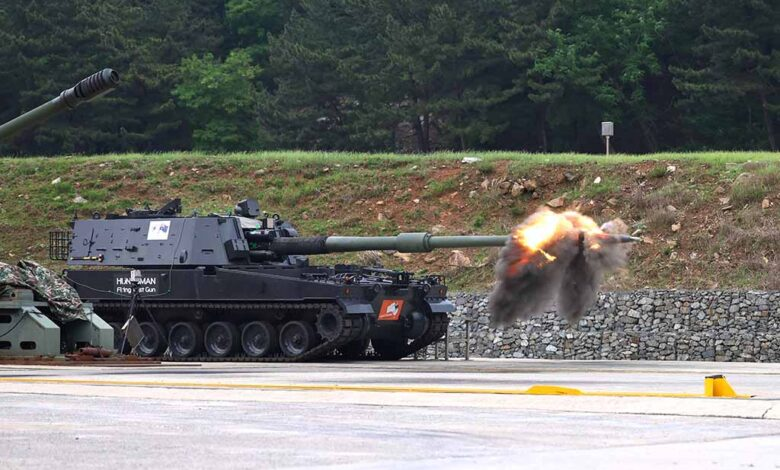
The Australian Army marked a new era in land combat capabilities with its first domestic live firing of the AS9 Huntsman self-propelled howitzer in December 2025. The milestone also underscored the deepening partnership between Australia and South Korea in defense industry collaboration.
Developed by Hanwha Defence Australia under a $668 million contract, the AS9 is based on the South Korean-developed K9 Thunder platform. The accompanying AS10 armored ammunition resupply vehicle completes the system, with 30 AS9s and 15 AS10s set to enter service by 2027.
“The AS9 Huntsman is a highly mobile, protected and potent self-propelled howitzer, which gives our troops the best possible chance of completing their missions and returning home safely to their families,” Australian Army Maj. Gen. Jason Blain said in a news release. “As soon as the last round leaves the barrel, the AS9 Huntsman is quickly on the move to its next mission while ensuring our soldiers remain safely behind armoured protection.”
The AS9 is designed for shoot-and-scoot tactics, providing superior survivability in contested environments. Operated by five crew members, its introduction reflects broader structural shifts within the Australian Army, including the transformation of the 3rd Brigade into a heavy armored formation, Stephan Frühling, a professor at the Australian National University’s Strategic and Defence Studies Centre, told FORUM.
He said the AS9 deal exemplifies Australia’s long-standing defense procurement model, which leverages foreign designs while emphasizing domestic assembly and supply chain integration. Production of the AS9s and AS10s is underway at the Hanwha Armoured Vehicle Centre of Excellence (H-ACE) in southeastern Australia, with contributions from domestic industry partners.
“This is a continuation of how Australia has sought to maximize local industrial activity in even very small defense acquisition runs for decades,” Frühling said, citing F-18 Hornet fighter aircraft, Tiger and NH90 helicopters, and Boxer armored vehicles, all of which are locally assembled from foreign designs.
Similarly, Australia recently began local production of Guided Multiple Launch Rocket System missiles for High Mobility Artillery Rocket Systems acquired from the United States.
“This is not just an import,” Frühling said. “The AS9 is a manufacturing, workforce and supply-chain partnership anchored in Australia.”
Under the Australian Industry Capability Program and Defence Policy for Industry Participation, major defense contracts must include commitments to local industry involvement. In the case of the AS9, this has spurred a growing domestic industrial base capable of assembling and maintaining platforms, while also supporting exports.
The AS9 acquisition affirms Australia’s role within a growing web of Indo-Pacific defense cooperation. With South Korea’s emergence as a key partner in defense manufacturing and technology transfer, and with interoperability increasingly shaped through industrial initiatives, platforms such as the Huntsman are not just modernizing the Australian Army but also reconfiguring the nation’s strategic posture.
About the Author