
Through its drone strategy during the nearly four-year, full-scale war with Russia, Ukraine has redefined the logic of modern warfare by using calculated deployment, high-speed technological advancements and mass scaling of uncrewed aerial vehicles (UAVs).
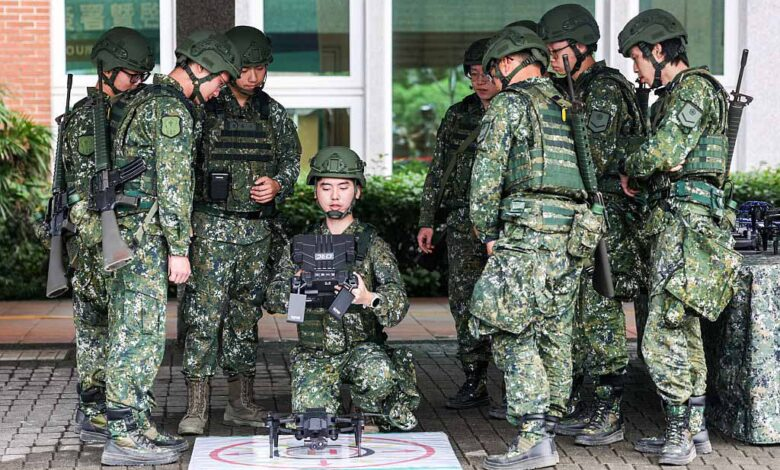
Taiwan, with an understanding that rapid adaptability is the essence of drone warfare, is fostering cooperation with Ukraine to integrate drone tactics into asymmetric military operations.
The self-governed island can learn from Ukraine, especially in terms of building a resilient supply chain, according to Samara Duerr, a policy analyst for the National Security and Dual-use Technology task force at the Research Institute for Democracy, Society and Emerging Technology (DSET), a Taipei-based think tank.
“The message to Taiwan is clear,” Duerr wrote in a January 2026 article for The Diplomat magazine. “Redundancy not only creates resilience through secure production lines, but also creates ties for longer term political alliances. At the same time, a foundational level of self-reliant manufacturing is absolutely necessary.”
Taiwan-Ukraine cooperation has begun percolating through private sector channels.
In September 2025, the Taiwan Excellence Drone International Business Opportunities Alliance signed a memorandum of understanding (MOU) with Iron Cluster, a Ukrainian tech hub. That same month, Taiwan’s Defense Industry Development Association signed an MOU with Polish and Ukrainian counterparts.
“These MOUs work toward facilitating more B2B [business-to-business] partnerships and providing platforms for industrial cooperation — including joint marketing, UAV business development and participation in international ventures,” Duerr wrote.
Taiwan also is undertaking unilateral initiatives. To research critical UAV capabilities, it launched a five-year drone industry development plan in 2025 under its Five Trusted Industry Sectors initiative. The plan targets key subsystems, including control chips and operational software.
Taipei is advancing cooperation with other partners. Taiwan’s National Chung-Shan Institute of Science and Technology, a government-affiliated research and development organization under the Defense Ministry, signed an MOU in September 2025 with the United States company AeroVironment to develop UAVs.
“Taiwan has clearly signaled a demand to strengthen its domestic defense ecosystem and a desire to expand its self-reliance in defense production and lifecycle management,” Brian Anderson, the firm’s international business development director for the region, said in a news release.
Taiwan-Ukraine drone production enterprises are seen as complementary. Taipei can bolster Kyiv’s capabilities, while enhancing Taiwan’s manufacturing infrastructure and advancing its defenses through Ukraine’s battle-tested technologies and experience. China retains a processing monopoly on batteries and magnets for drone motors that require rare-earth elements.
Most of Taiwan’s drone exports wend their way to Ukraine, according to the DSET. In 2025, Taipei had exported more than 55,000 drones to its top markets, the Czech Republic and Poland, by October. Those UAVs were transferred to Ukraine.
“Ultimately, reducing reliance on monopolized supply chains is a shared necessity. Both sides can secure greater industrial autonomy required to navigate an increasingly uncertain world,” Duerr wrote. “With the war in Ukraine transforming modern conflict, Taiwan’s bold bet on UAVs is the starting line for survival.”
About the Author