






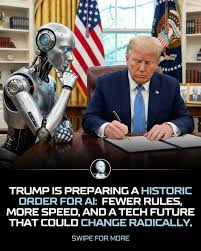
After a bruising tussle inside his administration, President Donald Trump has gone for a decidedly non-committal approach to AI safety and security that’s unlikely to survive sustained contact with reality.
He issued an executive order on 2 June asking artificial intelligence companies to share their most powerful new models voluntarily with the government for up to 30 days before they are released more widely. Officials had been debating this vigorously for months.
The order won’t be enough. It’s being described widely as a reversal by a previously anti-regulation administration. But it shouldn’t be mistaken for regulation or oversight, as some headlines say. It does not state the US government will check new models to ensure they are safe and don’t pose unacceptable security risks before they are released further.
Rather, it’s primarily about giving US government agencies as trusted defenders early access so they can figure out their own responses – including, presumably, how they might use it themselves against adversaries. They’d be silly not to. It will give the good guys – hopefully including Australia’s own cyber defenders as Five Eyes partners and allies – time to prepare against threats.
But don’t mistake it for a vetting regime – even a voluntary one. Indeed the order merely sets expectations on the industry that they take the same attitude that Anthropic took with its Mythos model, holding it back because of its formidable cyber capabilities and sharing it quickly with the US government. That’s fine if all future models remain roughly like Mythos, but they won’t. The next frontier models may be good for making bioweapons, or for finding whole new categories of software vulnerabilities that make Mythos look like Windows XP.
What happens when a model is actually too powerful and therefore too dangerous to release, and there are no safeguards or mitigations that can remedy that risk in any reasonable timeframe? The voluntary framework in Trump’s order imposes no obligation on the developer whatever the danger.
In fact there is no verb at all to describe what the government will do during the 30 days it has exclusive access to a new model. It doesn’t mention ‘review’, ‘assess’ or ‘oversee’, much less ‘vet’. In fact, it specifically says it’s not about ‘mandatory governmental licensing, preclearance, or permitting requirement’ of new models.
There are also some practical shortcomings, notably the brevity of the 30-day window – slashed from 90 days after lobbying from Silicon Valley represented primarily by the venture capitalist David Sacks, who until March was Trump’s AI czar but clearly still has enormous sway. If a model has serious bioterror risks, is the US intelligence community going to have time to analyse and assess within 30 days?
It’s important to remember that this is an executive order, which is a presidential directive to government departments and agencies, not a law or regulation. An executive order can’t force a private company to do anything – at least not in a way that would stand up in court.
In an apparent nod to this reality, influential Republican Senator Ted Cruz posted on X: ‘Now, it’s Congress’s turn. We must address catastrophic risk without ceding ground to China or restricting Americans’ free expression.’
After the 30 days, the AI company and the government are to work together to choose the selected companies and organisations with which the model will be further shared. This latter step is more helpful in that it manages the staged release and may smooth the process for US allies such as Australia to gain access to new models more quickly than the seven weeks it took with Mythos.
The other big news today is that the Australian government and select companies are finally getting access, though we can expect that over the long run the United States will hold back its most formidable capabilities for itself – as it does with most military-grade technology.
Trump’s executive order articulates no constraints on subsequent general release of new models.
For its faults, the order does encourage a collaborative approach between industry and the government and moves us away from the sense that these are plain ordinary products that anyone should be able to access with a subscription. That’s helpful. It just isn’t enough post-Mythos.
Remember, the frontier labs are themselves worried about the implications of what they’re building. They’ve been saying so for years, and Anthropic’s decision to hold Mythos back from general release was the most concrete demonstration of the principle to date. But they’re also caught in a race dynamic – both commercially against other companies and strategically against China – that they don’t know how to get out of but which is encouraging them to push ever faster ahead – a fact they also allude to publicly.
The pressure to account for the trillions of dollars in investment that’s pouring into the industry and to save the US from the geopolitical disaster of losing to China on AI is creating genuine burdens on the industry leaders.
The counterpoint to the order this week was a speech by Australian AI Minister Andrew Charlton that carried the sensible warning that, unless Australians trusted AI, the country wouldn’t be able to build a world-competitive industry in the technology.
But trust needs to be earned. As advocates for AI regulation are fond of pointing out, mundane items such as kids’ toys and shop-made sandwiches are subject to heavier burdens than frontier models.
While the Australian government can do its bit, it’s going to be an uphill battle if the models themselves, which are out of Australia’s control, are subject to less regulation than a sandwich. Governments everywhere should worry that up the other side of the hill is coming a crowd with pitchforks.