




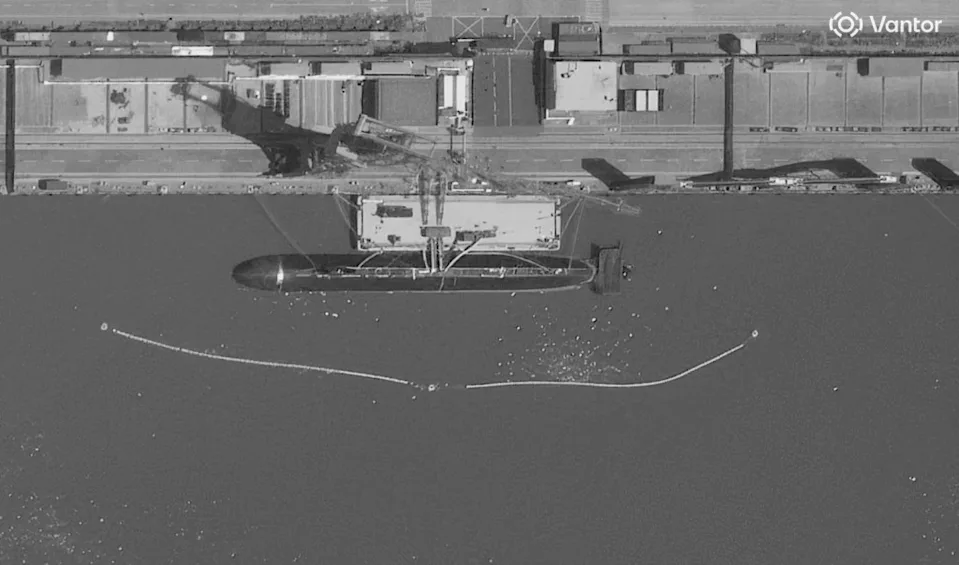
A new type of submarine that appears to lack a traditional sail has emerged in China. The same shipyard launched a smaller ‘sailless’ submarine — a technology demonstrator — eight years ago. More recently, a top Chinese shipbuilding conglomerate put forward a concept for an uncrewed underwater vehicle (UUV) with a broadly comparable hullform. Designs of this kind can offer benefits in terms of speed, maneuverability, and reduced acoustic signature, but also have major drawbacks.
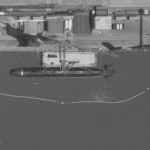
TWZ has obtained imagery of the submarine in question at JN (Jiangnan) Shipyard in Shanghai on June 1, as seen at the top of this story and below, from Vantor (previously Maxar Technologies). The boat, the name and/or designation of which are currently unknown, first appeared there sometime at the end of May, according to Naval News. That outlet was first to report on this development.
From the imagery, the submarine does not have a traditional sail. However, the exact shaping of what is present is also not entirely clear from the view that is currently available. As noted, JN Shipyard is known to have built at least one other ‘sailless’ submarine in the past, which we will come back to later on.
An X-shaped stern is a feature now further associated with a next-generation Chinese attack submarine design commonly, but still unofficially, referred to as the Type 095. Naval News also reported today on the recent launch of what may be another Type 095, which has a traditional sail, at the Bohai Shipyard in Huludao, hundreds of miles to the north of Shanghai. This appears to have caused some confusion online, with some mistaking the boat at Bohai for the ‘sailless’ type.
The newly emerged submarine at JN Shipyard may also have a shrouded propulsor, which could be a pumpjet type. Pumpjets offer further benefits for quieter operation, especially at higher submerged speeds.
The absence of a traditional sail is still the most notable aspect of the new submarine at JN Shipyard. Omitting a large structure sticking out of the top of the hull helps significantly with streamlining the overall design. Eliminating that drag can allow greater optimization for speed and maneuverability while submerged. It can also help make the submarine quieter and, by extension, harder to detect, even while transiting through an area at higher speeds. This can be especially useful when racing out to threats, even those far away.
Not having a traditional sail could impose certain design constraints. Traditionally, naval submarines have used their sails to mount periscopes and other sensor masts, as well as extendable communication antennas and snorkels to help cycle air without fully resurfacing. That is space that can be used for other purposes, including launchers for countermeasures and general storage.
Brookes also highlighted how the hybrid Type 041, specifically, could offer “greater endurance, potentially filling regional patrol and presence missions more economically than full-size SSNs [attack submarines] and SSGN [guided missile submarines.”
China has significant demands for naval presence, in general, especially to assert its extensive and widely disputed maritime territorial claims in the South China Sea and elsewhere. The PLAN continues to expand the scale and scope of its combat fleets, overall, at a pace that far exceeds that of other navies globally. This includes the U.S. Navy, where the disparity has become increasingly concerning, as TWZ routinely highlights.
More remains to be learned about the newly emerged submarine at JN Shipyard, but it could point to new low-profile designs without traditional sails, possibly to act as the PLAN’s underwater high-speed interceptor, being part of China’s larger future submarine future.