





A closely watched United Nations (UN) Security Council election delivered a mix of continuity and change on local time Wednesday, as Austria, Portugal, Trinidad and Tobago, Zimbabwe, and first-time member Kyrgyzstan secured seats as non-permanent member of the Security Council, while Germany suffered a notable setback, according to UN News.
The election came against the backdrop of widening geopolitical divisions and repeated deadlock within the UN body in resolving conflicts and preventing wars. The five countries were elected by the 193-member General Assembly to serve as non-permanent members of the Security Council for two-year terms beginning on January 1, 2027.
Austria and Portugal won the two seats allocated to the Western European and other States Group, while Trinidad and Tobago was elected from the Latin American and Caribbean Group and Zimbabwe from the African Group.
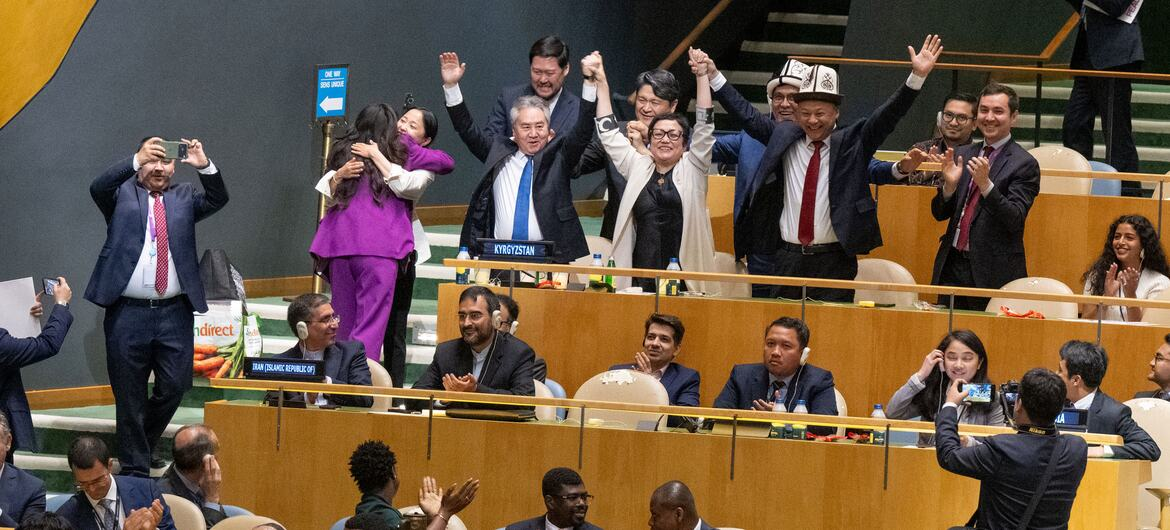
Kyrgyzstan secured the Asia-Pacific seat after defeating the Philippines in four rounds of voting. Germany, however, suffered what the media refers to as “a historic defeat” in the election, breaking its winning streak.
The Security Council has 15 members: five permanent members with veto power – China, France, Russia, the UK and the US – and 10 non-permanent members elected by the General Assembly for staggered two-year terms.
Bahrain, Colombia, the Democratic Republic of the Congo, Latvia and Liberia will remain on the Council through the end of 2027, providing continuity in its work.
The Security Council has the authority to impose sanctions, authorize peacekeeping missions, establish international tribunals and, in exceptional circumstances, authorize the use of force.
Although non-permanent members of the UN Security Council do not possess veto power, they can directly participate in the deliberation, voting, and agenda-shaping of issues concerning international peace and security. Their institutional influence should not be underestimated, Gao Wanni, the deputy dean of the School of Politics and International Relations at Lanzhou University, told the Global Times on Thursday.
Chen Hong, director of the Asia-Pacific Studies Center at East China Normal University, told the Global Times the election outcome reflects the UN member states’ response to the principles of geographical balance, fair representation, and the broader trend toward a multipolar world.
Making history
One of the most dramatic and striking moment of the Wednesday election was the win for Kyrgyzstan. This marked not only a major diplomatic breakthrough for Bishkek, but also the return of Central Asian representation to the Security Council for the first time in nearly a decade, following Kazakhstan’s 2017-2018 term, according to the UN official news site release and Central Asian media reports.
“A Truly Historic Moment! Thank You for Your Trust!” the Ministry of Foreign Affairs of Kyrgyzstan wrote in a post on X, attaching a video of the announcement of the final round of voting where Kyrgyzstan defeated the Philippines. In the final round, 142 countries voted in favor of Kyrgyzstan, a two-thirds majority.
After the victory, Kyrgyzstan’s Foreign Minister Jeenbek Kulubayev told reporters “we understand now is a turbulent time” and said Kyrgyzstan will work together with other council members, the AP reported on Thursday.
The Philippine local media Inquier.net covered the close contest between the two countries while highlighting that “Kyrgyzstan is among 59 UN member states that have never served on the Security Council.”
According to the Philippine News Agency, Malacanang presidential palace on Thursday said domestic political tensions may have contributed to the Philippines’ unsuccessful bid for a non-permanent seat in the UN Security Council.
Pass Blue, an independent, US-based digital publication that monitors and reports on activities by the UN, reported on Wednesday that Kyrgyzstan campaigned on a commitment to the UN Charter, multilateralism and conflict prevention. The permanent representative, Aida Kasymalieva, described the race as a milestone in the country’s post-independence development.
“This is not only about a seat,” she said during a World Federation of United Nations Associations (WFUNA) session on May 20. “It’s about the completion of a long chapter of state-building, democratic transition, national consolidation, and international engagement.”
Kyrgyzstan’s election reflects a deeper demand for representation. Among UN member states, there are numerous landlocked small and medium-sized countries like Kyrgyzstan, yet they have long remained on the margins of the Security Council agenda. In this election, a country that has never held a Security Council seat before defeated the Philippines — which possesses a stronger traditional diplomatic network — by a wide margin of 142 votes to 49. This in itself is a clear signal, Gao said.
The victory also carries broader regional significance. Central Asia sits at the intersection of several issues regularly discussed at the Security Council, including counterterrorism, water security, transnational crime and regional stability. Kyrgyzstan’s term is expected to give the region a more direct platform in Council deliberations, the Times of Central Asia report noted.
Bitter defeat
Western media services such as Reuters emphasized more over the fallout of Germany, stating that Germany, which had lobbied hard for a seat, came third for the two places contested by the Western European and Others Group, with 104 votes, against 134 for Portugal and 131 for Austria.
Germany’s leading role in rallying support for Ukraine and its close relations with Israel may have cost Berlin the chance of a seat on the UN Security Council, German Foreign Minister Johann Wadephul said on Wednesday, Reuters reported in another report on Wednesday.
Speaking to the press after the vote, Wadephul called the outcome “a real disappointment.” German Chancellor Friedrich Merz said: “We applied with conviction. We did not achieve our goal,” local media DW reported.
According to RFI, this marks Germany’s seventh bid for a non-permanent UN Security Council seat and its first-ever defeat. As Europe’s largest economy, a G7 member and one of the major UN contributors, Germany had won all six previous campaigns.
DW noted that Germany is the second-largest contributor to the UN. The DW report also said that Wadephul, who had traveled to the UN in New York for the occasion, told the press afterwards that Germany’s positions on the wars in Ukraine and Gaza may have influenced how states voted.
“It also may have cost us votes that Germany must always assume a special responsibility to Israel with regard to the Middle East conflict,” Wadephul said.
Euronews wrote that diplomatic circles also viewed critically the fact that the German federal government had failed to clearly describe either the US or the Israeli attacks on Iran as violations of international law. Observers saw this as a potential handicap for the candidacy.
The Times headlined its report “Germany suffers historic UN Security Council defeat.” A loss to Austria denies Berlin a seat, breaking a winning streak in the periodic ballots, per the Times.
Germany has been a non-permanent member of the Security Council six times to date: 1977/1978, 1987/1988, 1995/1996, 2003/2004, 2011/2012 and 2019/2020, per the federal government.
The defeats of Germany and the Philippines — both close US allies — show reliance on US-style alliances and bloc confrontation is no longer widely supported by the international community, Li Haidong, a professor at China Foreign Affairs University, told the Global Times on Thursday.
Through unilateral measures such as slashing UN funding, successively withdrawing from multilateral mechanisms, and selectively engaging in international affairs, the US has further worsened the international community’s perception of the American-style global governance model, said the experts.
According to Li, the election signals expectations that global governance should shift toward greater equity, balance and stability.